



When you are unsure whether to write says or sais, the correct choice in standard English is says. The word “says” is the third-person singular present form of the verb “say,” while “sais” is not the standard English spelling of that verb.
The confusion is understandable because says pronunciation does not match the way the word “say” sounds. “Say” is pronounced /seɪ/, but “says” is pronounced /sez/, which is why some people accidentally create the phonetic spelling “sais.” also want to know Excel or Accel: Which Word Is Correct?
Says or Sais: Quick Answer
The correct spelling is says.
Use says when the subject is he, she, it, or another singular subject:
- She says she is tired.
- He says the store is closed.
- The teacher says the test is tomorrow.
- Everyone says this restaurant is popular.
“Sais” is not the correct spelling of the English verb “say” in these sentences. In standard English, the correct form is always says.
A simple way to remember it is:
say + s = says
The spelling follows the normal present-simple pattern in which English verbs generally take -s with a third-person singular subject.
Is “Says” or “Sais” the Correct Spelling?
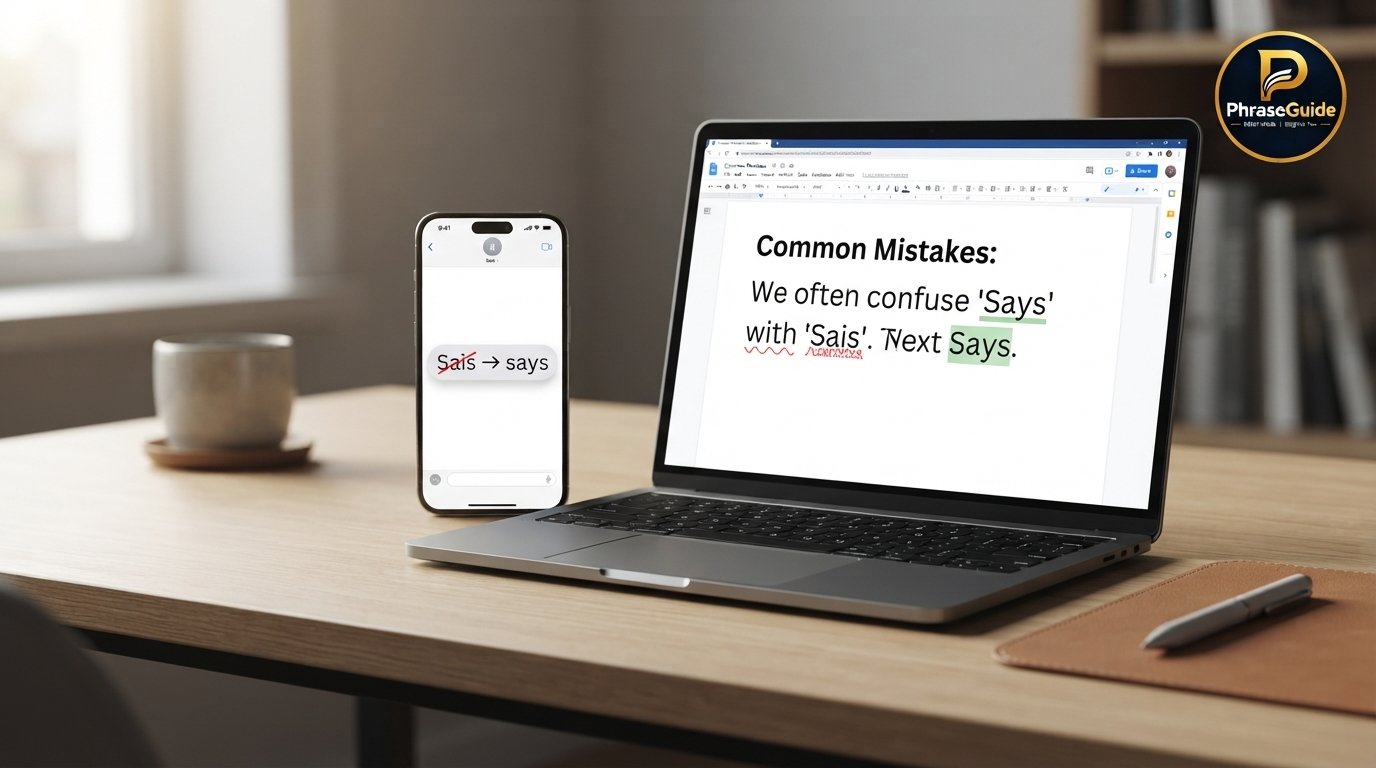
Says is the correct spelling in standard English.
The base word is say, which means to speak words, express a thought, state an opinion, or communicate information. Cambridge Dictionary lists say as an English verb and gives its past form as said.
When “say” is used with a singular third-person subject in the present tense, it becomes says:
| Subject | Correct form |
|---|---|
| I | say |
| You | say |
| We | say |
| They | say |
| He | says |
| She | says |
| It | says |
This is a basic English verb conjugation pattern. The present simple normally uses the base verb with I, you, we, and they, but adds -s for he, she, and it.
So:
- I say what I think.
- They say the food is good.
- She says what she thinks.
- The sign says “Do not enter.”
The word “sais” may look reasonable because of the way “says” sounds, but it is an incorrect spelling of says when you are writing standard English.
What Does “Says” Mean?
Says meaning is simple: it is the present-tense form of “say” used with a third-person singular subject.
“Say” can be used when someone speaks, gives information, expresses an opinion, or communicates a message.
For example:
- Maria says she needs more time.
- The sign says the road is closed.
- My brother says he will call later.
- The article says that the event begins at 7 p.m.
The exact meaning depends on the sentence, but the grammatical role stays the same.
One useful point is that says refers to the present form of the verb. It does not mean that the person is speaking at this exact second. It can describe something someone regularly says or a statement that is currently presented as true.
For example:
John says he works from home.
This means John states or reports that he works from home.
The word can also introduce reported speech:
She says, “I’m ready.”
Here, “says” introduces the words that follow.
How to Use “Says” in a Sentence
Learning how to use says becomes easier when you first identify the subject.
Use says with a singular third-person subject:
He says the movie starts at eight.
She says the package has arrived.
The manager says the office will open at nine.
The website says the product is available.
The subject does not have to be a person. Any singular noun can take “says” when it performs the role of the speaker or source of information.
Compare these sentences:
- I say that every day.
- We say hello when we arrive.
- They say it is too expensive.
- He says it is too expensive.
The last sentence uses says because “he” is third-person singular.
This is also important with words such as everyone. Although “everyone” refers to many people, it is grammatically treated as singular:
Everyone says the same thing.
Not:
Everyone say the same thing.
The same principle applies to singular nouns:
The report says the project is complete.
My sister says she is busy.
The company says the product is safe.
These examples show the correct usage of says in everyday writing, professional communication, and ordinary conversation.
Why Is “Sais” a Common Spelling Mistake?
The main reason people confuse these words is pronunciation.
When you hear “says,” you may expect its spelling to resemble the sound “sez.” Instead, English writes it as says, which keeps the spelling connected to the base word “say.”
Cambridge gives the pronunciation of “say” as /seɪ/ and “says” as /sez/.
That difference can lead to a common spelling mistake: writing the word the way it sounds.
For example:
❌ She sais she is coming.
✅ She says she is coming.
This is a good example of why English spelling cannot always be predicted from pronunciation. The sound of a word may suggest one spelling, while the standard written form follows a different pattern.
Another reason is fast typing. When people write messages quickly, they may rely on sound rather than stopping to think about the base word say. Once you remember “say + s,” the problem becomes much easier to avoid.
The same issue can appear in texts, emails, school assignments, social media posts, or casual online writing. It is simply one of those common English mistakes that becomes easier to correct once you understand where the confusion comes from.
Says vs Sais: Correct and Incorrect Examples
Here are practical examples that make the difference clear:
| Incorrect | Correct | Why? |
|---|---|---|
| She sais she is ready. | She says she is ready. | “Says” is the standard English form. |
| He sais he knows the answer. | He says he knows the answer. | “He” takes the third-person singular form. |
| The sign sais “Stop.” | The sign says “Stop.” | A singular noun takes “says.” |
| Everyone sais it is easy. | Everyone says it is easy. | “Everyone” is grammatically singular. |
| The teacher sais the class is canceled. | The teacher says the class is canceled. | “Teacher” is singular. |
If you are checking sais vs says, remember that “sais” should not replace “says” simply because the pronunciation sounds closer to it.
More examples of says in a sentence
Correct:
- She says she will finish tonight.
- He says the answer is obvious.
- The label says “Keep refrigerated.”
- My friend says this is the best option.
- The schedule says the train leaves at noon.
Incorrect:
- She sais she will finish tonight.
- He sais the answer is obvious.
- The label sais “Keep refrigerated.”
- My friend sais this is the best option.
- The schedule sais the train leaves at noon.
The difference is only one letter, but that letter matters in standard English.
How Do You Pronounce “Says”?
The word says is pronounced /sez/ in English, not “sayz.”
Cambridge Dictionary gives the US pronunciation as /sez/. The word “say,” by comparison, is pronounced /seɪ/.

A simple pronunciation guide is:
says → sez
Think of the beginning of the word “session,” followed by a z sound at the end.
This unusual spelling is one reason people ask why is says pronounced sez. The pronunciation is not obvious from the letters “ay,” but the written form remains says.
British and American English both use the familiar pronunciation “sez,” although accents can affect the exact sound. The important point for spelling is the same in both varieties: write says, not “sais.”
So:
- say → /seɪ/
- says → /sez/
- said → /sed/
- saying → /ˈseɪ.ɪŋ/
Says, Say, Said, and Saying: What’s the Difference?
The words say, says, said, and saying all come from the same verb say, but they have different grammatical forms and uses.
| Form | Use | Example |
|---|---|---|
| say | Base/present form | I say what I mean. |
| says | Third-person singular present | She says what she means. |
| said | Past tense and past participle | She said it yesterday. |
| saying | -ing form | She is saying something important. |
Say
Use say with I, you, we, and they in the present simple:
I say hello every morning.
They say the store is closed.
Says
Use says with he, she, it, and singular nouns:
He says he is tired.
The note says the meeting starts at ten.
Said
Said is the past tense said form of “say”:
She said she was busy yesterday.
Cambridge identifies “said” as the past form of “say.”
Saying
Saying is the -ing form:
She is saying that she needs help.
The word “saying” can also be a noun for a familiar phrase or statement, as in:
“Actions speak louder than words” is a common saying.
Understanding these forms can prevent another common error: using “says” when the sentence clearly refers to the past.
For example:
❌ She says that yesterday.
✅ She said that yesterday.
Is “Sais” Ever Correct in English?
For the English verb “say,” sais is not the standard spelling. So when someone asks is sais correct, the answer is no when they are trying to write the present form of “say.”

However, there is an important language detail behind the sais meaning. Sais is a real word in French. It is a present-tense form of the French verb savoir, which means “to know.” French conjugation uses je sais and tu sais, for example.
That does not make “sais” an English alternative to “says.”
So in English:
✅ She says she knows.
Not:
❌ She sais she knows.
In French:
Je sais = I know
Tu sais = You know
This distinction is useful because it explains why you may occasionally see “sais” online or in another language. The word can exist outside English, but it is not the correct spelling for the English third-person singular form of “say.”
How to Remember the Correct Spelling of Says
The easiest memory trick is to start with the base word say.
Think:
SAY + S = SAYS
Do not try to spell the word from the way it sounds. The pronunciation “sez” can make “sais” look tempting, but the spelling is connected to say.
Another useful trick is to check the subject:
I → say
You → say
We → say
They → say
He → says
She → says
It → says
When the subject is singular and third person, choose says.
You can also remember this sentence:
“She says, but I say.”
That short contrast is enough to reinforce the grammatical difference and help prevent one of the most common words commonly misspelled in everyday writing.
If you are proofreading your own work, search for “sais.” When you find it, ask whether you actually mean the English verb “say.” In most ordinary English sentences, the correction will be says.
Frequently Asked Questions
What is the meaning of sais?
In the context of English, “sais” is generally a misspelling of “says.” In French, sais is a form of savoir, meaning “know.”
What is the difference between said and says?
“Says” is the present form used with a third-person singular subject, while “said” is the past form of “say.”
How do British people pronounce “says”?
“ Says” is commonly pronounced like “sez,” rather than “sayz.” Cambridge gives /sez/ as the English pronunciation.
Is says correct grammar?
Yes. “Says” is grammatically correct when used as the third-person singular present form of “say,” such as “She says she is ready.”
Is “says” a word?
Yes. “Says” is a standard English verb form derived from “say” and is widely used in present-tense sentences.
Is “I says” grammatically correct?
In standard English, “I say” is the normal form. “I says” can occur in some dialects or informal speech, but it is not standard grammar.
Conclusion
When choosing between says or sais, always use says when writing standard English. It is the third-person singular present form of the verb “say,” while “sais” is not the standard English spelling of that verb.
The easiest rule is simple: say + s = says. Even though the word is pronounced “sez,” its spelling stays connected to the base word “say.” Once you remember that difference, the sais vs says confusion becomes much easier to avoid.
Whether you are writing a school assignment, email, article, text message, or professional document, says is the correct choice when the subject is he, she, it, or another singular noun.



[…] people confuse a word’s sound with its written form. For example, you can read our guide to Says or Sais: Which Spelling Is Correct? for another example of this type of English spelling […]
[…] This is an example of spelling confusion caused by homophones: words that share the same pronunciation but have different meanings and spellings. You can encounter similar challenges in other English spelling questions, such as Says or Sais: Which Spelling Is Correct?. […]