



If you are wondering whether affended or offended is correct, the answer is offended. The word affended is not the standard spelling in English and is normally used as a spelling mistake for “offended.”
The confusion is easy to understand because people sometimes spell unfamiliar words according to how they hear them. It can also happen while typing quickly or when a word is remembered incorrectly. In this guide, you’ll learn the correct spelling, the meaning of offended, how to use it naturally, and how to tell it apart from related words here is our complete guide on grammar spelling word usage.
Affended or Offended: What Is the Correct Spelling?
Offended is the correct spelling.
It comes from the verb offend, which means to upset, insult, or cause displeasure to someone. When you are talking about something that already happened, the usual past form is offended.
For example:
- ✅ I hope I didn’t offend you.
- ✅ She was offended by his comment.
- ✅ They felt offended by the joke.
- ❌ I hope I didn’t affend you.
- ❌ She was affended by his comment.
A useful way to remember the spelling is to start with the base word:
offend → offended
The same off- beginning remains in both forms.
This is similar to other common English spelling questions where people confuse a word’s sound with its written form. For example, you can read our guide to Says or Sais: Which Spelling Is Correct? for another example of this type of English spelling confusion.
Is “Affended” a Real English Word?
In standard modern English, affended is not recognized as the normal form of this word. When people write it, they are generally attempting to write offended.
That means “affended” does not have a separate word meaning that you should use in ordinary English. You may occasionally see the spelling in an online comment, typo, joke, or informal post, but that does not make it the correct form.
The same applies to searches for affend meaning. In most cases, the searcher wants to know what offend means.
Compare these:
- ❌ His words affended me.
- ✅ His words offended me.
For school assignments, emails, articles, applications, and other forms of professional writing, it is best to use the recognized form.
What Does “Offended” Mean?
The offended meaning depends slightly on context, but it generally describes a person who feels hurt, insulted, disrespected, or upset because of something that was said or done.
The base verb offend can therefore describe several situations.
A person may be offended when their feelings are hurt:
I was offended by the way he spoke to me.
It can also refer to an insult or disrespectful remark:
She felt offended by the personal comment.
Sometimes something simply causes strong displeasure:
The behavior offended many members of the audience.
In another context, offend can refer to violating a rule, standard, or law:
The company was found to have offended certain regulations.
So, although the emotional meaning is the one people use most often in everyday communication, the verb can have a broader meaning.
Why Do People Write “Affended” Instead of “Offended”?
There are a few simple reasons behind this spelling confusion.
One is pronunciation confusion. When “offended” is spoken quickly, the first syllable may not sound as clear as it looks when written. Someone who has never seen the word written down may therefore guess the spelling incorrectly.
Typing speed can also play a role. A person may know the word but accidentally hit “a” instead of “o.”
Another reason is memory. English contains many words with different prefixes and similar sounds, so it is possible to remember the structure incorrectly even after hearing a word many times.
People also encounter informal writing online every day. A typo can be repeated in comments or messages simply because other readers understand the intended meaning.
Even so, the correct word choice does not change:
offend ✅
offended ✅
affend ❌
affended ❌
How to Pronounce “Offended” Correctly

To pronounce offend, say the word with the stronger stress on the second syllable:
uh-FEND
The word offended is commonly pronounced approximately like:
uh-FEN-did
Breaking it into parts can make it easier to connect the sound with the spelling:
offend → off-ended
You do not need to exaggerate the individual sounds when speaking naturally. The main thing is to remember that the word begins with off-, not “af-.”
Pronunciation can sometimes influence spelling, but checking the written form is more reliable than spelling purely from sound.
Offend, Offended, Offending, and Offensive: What’s the Difference?
These words are related, but they serve different purposes in a sentence.
| Word | What it does | Example |
| Offend | Describes the action of upsetting or insulting someone | I didn’t want to offend her. |
| Offended | Describes someone who felt hurt or insulted | He was offended by the remark. |
| Offending | Refers to something causing the problem | The offending post was removed. |
| Offender | Refers to a person who commits a violation | The offender was identified. |
| Offensive | Describes something considered insulting or unacceptable | The language was offensive. |
The easiest relationship to remember is:
offend → offended → offending
And:
offend → offensive
A very common error is to use offensive when you actually mean offended.
For example:
- ✅ I was offended by the comment.
- ✅ The comment was offensive.
The first sentence describes the person’s reaction. The second describes the comment.
Understanding these word forms makes correct usage much easier.
How to Use “Offended” Correctly in a Sentence
Use offended when you are describing a person’s reaction to something that has already happened.
For example:
I was offended by the way he spoke to me.
Here, the person experienced a negative reaction in the past.
In everyday conversation, you might hear:
I didn’t mean to offend you.
Notice that the sentence uses offend, not “offended,” because it follows “to.”
You can also say:
She felt offended by the joke.
In a workplace setting:
He was offended by the tone of the email.
For social media:
Some readers were offended by the post.
In more formal English:
The statement offended several members of the audience.
A useful comparison is:
- to offend = the action
- offended = the person’s reaction
- offensive = a description of the thing causing the reaction
Getting this distinction right improves both grammar and correct usage.
Affended vs. Offended: Side-by-Side Comparison
| Spelling | Correct? | Meaning | Example |
| Affended | ❌ No | Usually a spelling mistake | ❌ I was affended. |
| Offended | ✅ Yes | Felt hurt, insulted, or upset | ✅ I was offended. |
| Offend | ✅ Yes | To hurt, insult, or upset someone | ✅ I didn’t mean to offend you. |
The affended vs offended difference is therefore straightforward: offended is the standard form.
The same rule applies in different types of writing. Whether you are writing a text, comment, school paper, or business email, the spelling does not change.
One helpful memory rule is to keep the first two letters in mind:
OF + FEND = OFFEND
Then add -ed when you need the past form:
OFFEND + ED = OFFENDED
Offended vs. Offense vs. Offence: Related Word Forms

These words belong to the same word family, but they are not synonyms.
Offended describes a person’s reaction:
She was offended by the remark.
Offense is the noun commonly used in American English:
The remark caused offense.
Offence is the corresponding noun spelling in British English:
The remark caused offence.
The important point for a US audience is that the verb remains offend and the past form remains offended in both varieties.
| Word | American English | British English |
| Verb | offend | offend |
| Past form | offended | offended |
| Noun | offense | offence |
| Adjective | offensive | offensive |
So if you’re writing for US readers, offense is the usual noun spelling. For British readers, offence is preferred.
Common “Affended” and “Offended” Mistakes With Correct Examples
Here are some common mistakes that can make the intended meaning less clear.
Wrong initial spelling
❌ I didn’t mean to affend anyone.
✅ I didn’t mean to offend anyone.
Wrong past form
❌ She was affended by his response.
✅ She was offended by his response.
Using “offend” after “was”
❌ I was offend by the comment.
✅ I was offended by the comment.
Confusing “offended” and “offensive”
❌ I was offensive by the remark.
✅ I was offended by the remark.
Using the British noun spelling in US-focused writing
❌ The comment caused offence.
✅ The comment caused offense.
The last example is not an error in all forms of English. It is a difference between American English and British English, so the correct form depends on your audience.
For another useful comparison between easily confused English words, see Excel or Accel: Which Word Is Correct?.
Easy Ways to Remember the Correct Spelling
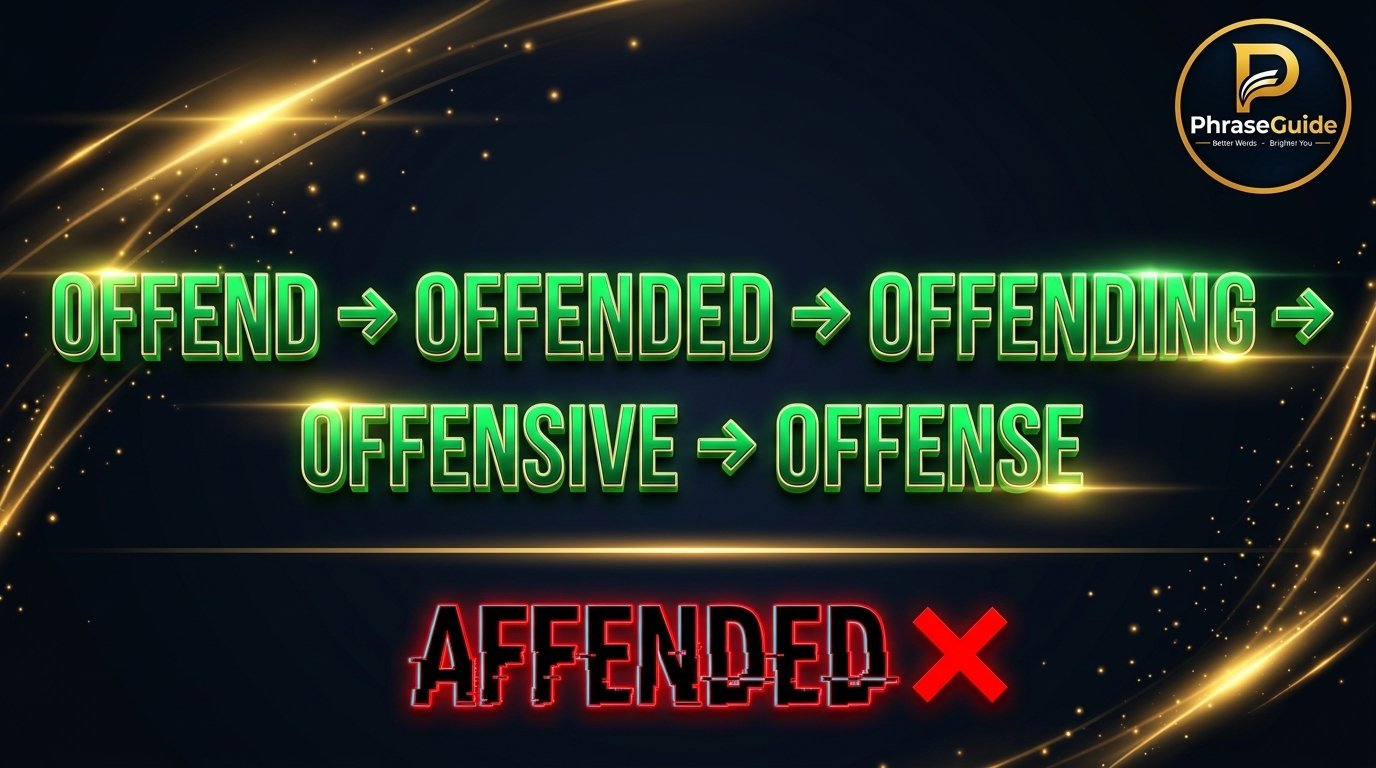
The simplest memory trick is:
OFFEND starts with OFF.
When you need the past form, add -ed:
OFFEND → OFFENDED
You can also remember the larger word family:
OFFEND → OFFENDED → OFFENDING → OFFENSIVE → OFFENSE
This pattern is more useful than trying to memorize “affended” as a separate word.
Another good habit is to think about the base word before writing the past form. Instead of asking yourself how “affended” sounds, ask:
What is the base verb?
The answer is offend.
That gives you the correct forms automatically.
If you are interested in other spelling and word-usage questions, PhraseGuide also covers specialized English vocabulary, including Scientific Words Starting With J.
FAQs
Is it affended or offended?
Offended is the correct spelling. “Affended” is generally an incorrect spelling of offended.
What does “afend” mean?
“Afend” is not a standard English word. It is usually a misspelling of offend.
What does “offended” mean?
Offended means feeling hurt, insulted, upset, or disrespected because of something someone said or did.
What is another word for “offended”?
Depending on the context, alternatives include hurt, insulted, upset, annoyed, and displeased.
What are 5 good synonyms?
Five useful synonyms for offended are hurt, insulted, upset, annoyed, and displeased.
Conclusion
The correct spelling is offended, while affended is an incorrect form that usually results from a typing, pronunciation, or memory mistake.
Remember the basic pattern:
offend → offended → offending → offensive
Once you connect the word to its off- beginning, it becomes much easier to use the correct form in everyday conversation, school writing, and professional communication.