

Jokes, Puns & Wordplay: Funny Ideas, Examples & Everything You Need to Know
Looking for something funny to say, write, or share? Jokes, puns, and wordplay can turn an ordinary sentence into something memorable.
Whether you want a clever caption, a funny text, a quick one-liner, or simply something to make people laugh, word-based humor gives you plenty of options. Some jokes are simple and silly, while others depend on double meanings, clever wording, or unexpected twists.
At PhraseGuide, we make funny language easier to understand and easier to use. This guide explains what jokes, puns, and wordplay mean, how they are different, the main types you will find, and how to create your own.
What Are Jokes, Puns & Wordplay?
Jokes, puns, and wordplay are all forms of humor, but they work in different ways.
A joke is a humorous statement, story, question, or situation designed to make someone laugh. A joke often builds toward a punchline that creates an unexpected or funny ending.
A pun is a type of wordplay that uses words with multiple meanings, similar sounds, or different interpretations to create humor.
Wordplay is the broader category. It involves using language in a clever, playful, or unusual way. Puns are one of the most common forms of wordplay, but wordplay can also include rhymes, double meanings, sound similarities, and creative expressions.
For example:
Joke:
“Why did the computer go to the doctor? Because it had a virus.”
Pun:
“I used to be a baker, but I couldn’t make enough dough.”
Wordplay:
“I wondered why the baseball kept getting bigger. Then it hit me.”
The main idea is simple: jokes focus on humor, puns focus on clever meanings or sounds, and wordplay covers a much wider range of language tricks.
What Is the Difference Between a Joke, Pun & Wordplay?
These terms are closely related, so it is easy to confuse them.
| Type | What It Does | Simple Example |
|---|---|---|
| Joke | Creates humor through a setup and funny ending | “Why was the math book sad? It had too many problems.” |
| Pun | Plays with meanings or sounds of words | “I’m reading a book about anti-gravity. It’s impossible to put down.” |
| Wordplay | Uses language creatively for humor or effect | “A bicycle can’t stand on its own because it is two-tired.” |
A single joke can contain a pun, and a pun can appear without being part of a traditional joke.
Think of wordplay as the big category, with puns being one popular type of wordplay and jokes being the larger form of humor that may use many different techniques.
Popular Types of Jokes

Jokes come in many styles. What one person finds hilarious may seem silly to another, so it helps to know the different forms.
One-Liner Jokes
One-liners are short jokes that deliver the humor in a single sentence.
Example:
“I told my suitcase there would be no vacation this year. Now I’m dealing with emotional baggage.”
They are especially useful for captions, texts, social media posts, and quick conversations.
Question-and-Answer Jokes
These jokes usually begin with a question such as “Why did…” or “What do you call…?” and finish with an unexpected answer.
Example:
“What do you call a sleeping bull? A bulldozer.”
They are easy to remember and work well for kids and adults.
Knock-Knock Jokes
Knock-knock jokes use a predictable conversation pattern and usually end with a pun or silly punchline.
They are classic, easy to tell, and especially popular with younger audiences.
Dad Jokes
Dad jokes are intentionally simple, cheesy, and often predictable. Their charm comes from being so corny that they become funny.
Example:
“I’m afraid for the calendar. Its days are numbered.”
Observational Jokes
These jokes take an ordinary situation and point out something funny or relatable about it.
For example, a joke may focus on grocery shopping, awkward conversations, school, work, family life, or everyday technology.
Dark or Edgy Humor
Some jokes use uncomfortable, surprising, or serious subjects for humorous effect. This style can be highly audience-dependent, so it is important to consider who will hear or read the joke.
For general audiences, light, clever, and relatable humor is usually easier to share.
Popular Types of Puns
Puns can be short, clever, cheesy, or surprisingly sophisticated. Here are some of the most common types.
Homophonic Puns
These use words that sound alike but have different meanings.
For example:
“I need to sea what happens next.”
The humor comes from using a word in an unexpected way.
Homographic Puns
These use a word that has the same spelling but more than one meaning.
For example, the word “bark” can refer to the sound of a dog or the outer covering of a tree.
Double-Meaning Puns
These use a phrase that can be understood in two different ways.
The reader initially interprets it one way and then realizes there is another meaning.
Visual Puns
Visual puns combine language with an image or physical situation to create humor.
For example, a picture of a sleeping cat beside the words “Purr-haps later” combines an image with a playful phrase.
Compound Puns
Compound puns connect multiple words or meanings to make a longer humorous expression.
These are common in themed joke collections because they allow writers to build several related jokes around one subject.
What Is Wordplay?
Wordplay is the creative use of language to make writing more interesting, funny, surprising, or memorable.
It does not always have to be a traditional joke.
Writers use wordplay in:
- Headlines
- Advertisements
- Social media captions
- Books
- Poems
- Movie titles
- Business names
- Speeches
- Text messages
- Greeting cards
- Funny signs
Wordplay can depend on pronunciation, spelling, meaning, rhyme, repetition, or unexpected combinations of words.
For example:
“Time flies like an arrow; fruit flies like a banana.”
The sentence becomes funny because the word “flies” changes meaning depending on how you read it.
Why Do People Enjoy Puns and Wordplay?
Part of the fun comes from surprise.
When people read a familiar phrase, they naturally expect a certain meaning. A clever pun interrupts that expectation and replaces it with another interpretation.
That small mental switch can make a simple sentence feel clever.
Puns can also make language more memorable. A creative phrase is often easier to remember than a plain statement, which is one reason wordplay appears so often in advertising, entertainment, and everyday conversation.
Of course, not every pun needs to be brilliant. Sometimes the fact that a pun is deliberately cheesy is exactly what makes it entertaining.
Funny Jokes, Puns & Wordplay Examples
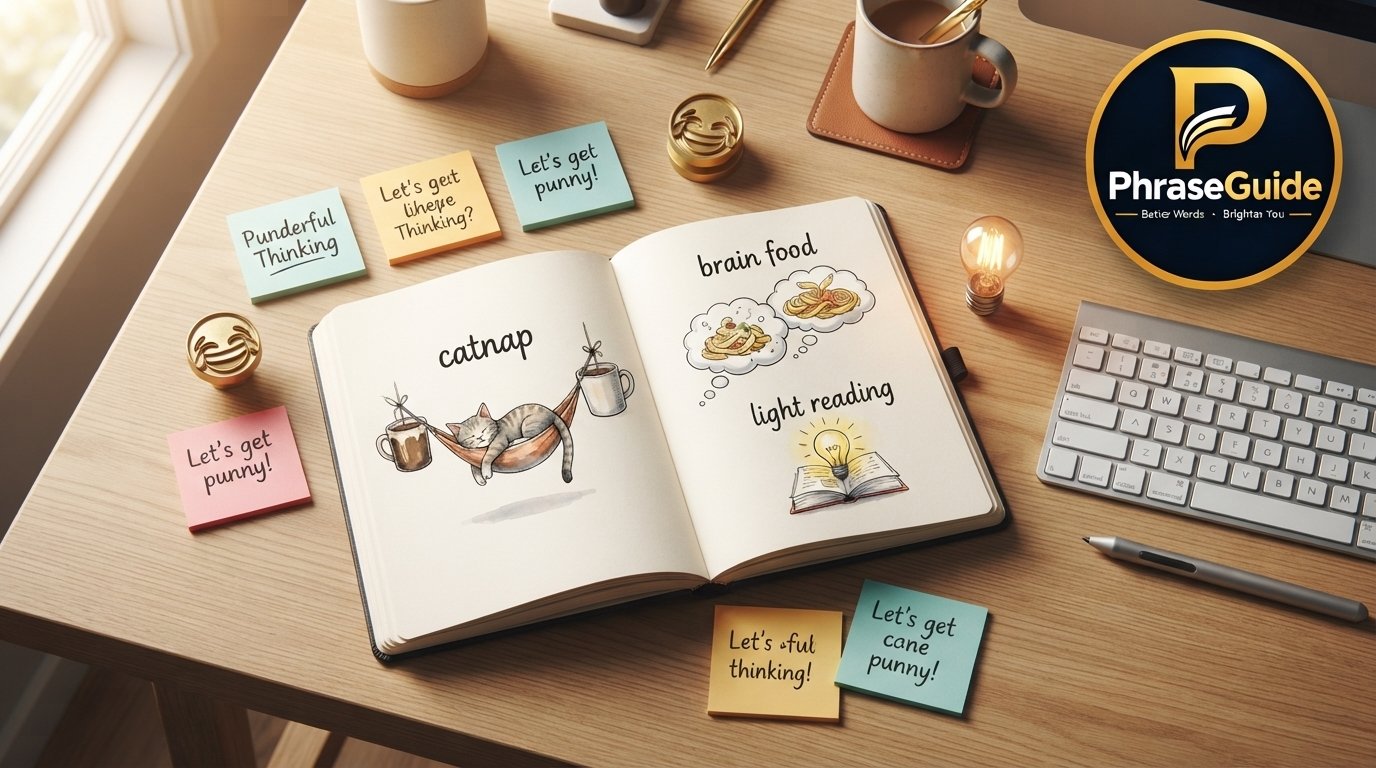
Here are some simple examples to show how different forms of word-based humor work.
Funny One-Liners
- I only know 25 letters of the alphabet. I don’t know y.
- I used to be addicted to the hokey pokey, but I turned myself around.
- I’m on a seafood diet. I see food and I eat it.
- I would tell you a construction joke, but I’m still working on it.
- I don’t trust stairs. They’re always up to something.
- I’m friends with all electricians. We have good current connections.
- I used to play piano by ear, but now I use my hands.
- My calendar is under a lot of pressure. Its days are numbered.
- I wanted to make a pencil joke, but it was pointless.
- I don’t trust atoms. They make up everything.
Simple Puns
- I’m having a grape day.
- Lettuce celebrate!
- You are tea-rific.
- Donut worry about it.
- That’s nacho problem.
- I’m very fondue you.
- You’re one in a melon.
- Have an unbe-leaf-able day.
- I’m simply pawsome.
- That’s the way the cookie crumbles.
These short expressions can work well in captions, cards, texts, party messages, and casual conversations.
Themed Jokes and Puns
One of the easiest ways to find good wordplay is to choose a subject first.
Popular themes include:
- Food
- Animals
- Sports
- School
- Work
- Holidays
- Relationships
- Movies
- Nature
- Hobbies
- Science
- Technology
- Family
- Seasonal events
Once you have a topic, think about words associated with it. Then look for words that sound similar, have multiple meanings, rhyme, or can be combined into a familiar phrase.
For example, food provides endless opportunities for puns because many food names can be turned into playful expressions.
Our collection of 300+ Hot Dog Jokes is a good example of how one simple food topic can inspire many different jokes, silly punchlines, and cheesy lines.
Animals are another huge source of wordplay. A single animal name can often lead to multiple expressions and sound-based jokes.
For more ideas, explore these 300+ Rat Puns for funny, cute, clever, and playful examples built around one animal theme.
How to Write Your Own Pun
Creating a good pun does not require advanced writing skills. Start with a simple process.
1. Choose a Topic
Pick something specific such as coffee, cats, woodworking, school, pizza, or Halloween.
A narrow topic makes it easier to find connected words.
2. Make a Word List
Write down as many related words as possible.
For example, if your topic is coffee, you might think of:
Bean, brew, mug, roast, espresso, cup, grounds, latte, drip, hot, steam.
3. Look for Similar Sounds
Ask yourself which words sound like other words.
You might also look for words that can be split into different phrases.
4. Find Double Meanings
Some of the funniest puns come from words that have more than one meaning.
Think about whether a familiar expression can be interpreted differently.
5. Keep It Clear
A clever pun is only useful when people can understand it.
Do not make the wording so complicated that the reader needs to solve a puzzle before getting the joke.
6. Add a Twist
The final step is to take the expected phrase and give it an unexpected turn.
That little surprise is often where the humor comes from.
Whether you enjoy ocean-themed jokes, clever wordplay, or silly one-liners, these algae puns are part of the bigger world of Jokes, Puns & Wordplay.
How to Make a Joke Funnier
A good joke is not always about having the cleverest words. Delivery and context matter too.
Here are a few simple principles:
Keep it relevant. A joke works better when it matches the situation.
Don’t over-explain the punchline. Once the joke is explained, much of the surprise disappears.
Use unexpected endings. A predictable answer usually has less impact.
Know your audience. A joke for children, coworkers, close friends, or a social media audience may need a different style.
Keep short jokes short. If the funny part can be said in one sentence, there is usually no reason to turn it into a paragraph.
Use natural language. A joke should sound like something a real person might actually say.
Funny Puns for Different Situations
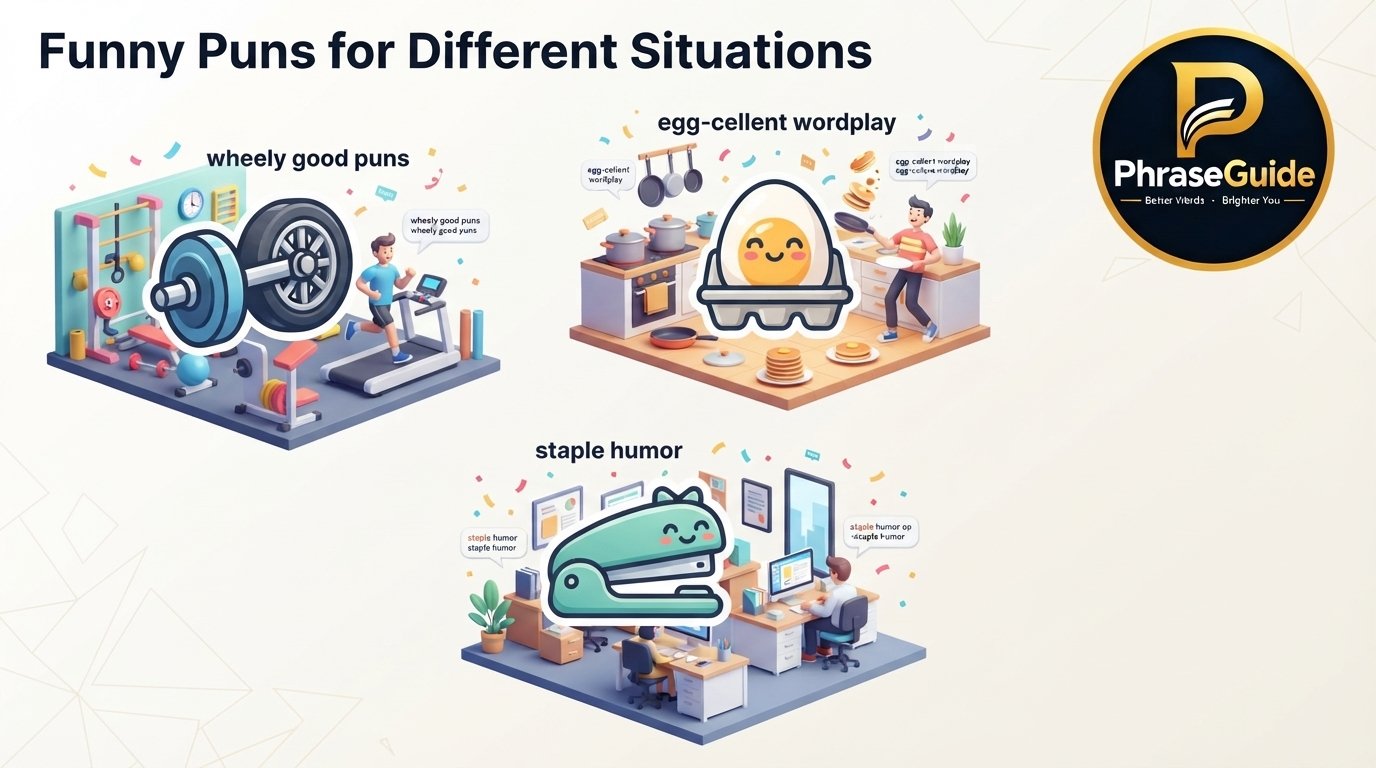
Different situations call for different types of wordplay.
For Text Messages
Short puns and quick one-liners work best because people usually want something easy to read and reply to.
For Social Media Captions
Visual puns, short jokes, and clever phrases can make ordinary posts more memorable.
For Birthday Messages
Lighthearted jokes and personalized puns can make a birthday message feel less generic.
For School
Clean jokes, science puns, subject-related humor, and simple wordplay are easy choices.
For Work
Keep workplace humor friendly and appropriate. Light jokes about meetings, deadlines, coffee, emails, or office life can work well.
For Cards and Gifts
A short pun can add personality to a greeting card, gift tag, or note without taking attention away from the main message.
Funny Hobby-Based Puns
Almost any hobby can become a source of wordplay.
Woodworking is a great example because the subject has so many words that can be used creatively, including terms related to tools, wood, cutting, building, and crafting.
For a larger collection, check out our 200+ Woodworking Puns featuring funny and clever lines for woodworkers, DIY fans, makers, and anyone who enjoys a good workshop joke.
The same approach can work for almost anything. Start with the vocabulary of the subject, then look for words that can be twisted into familiar expressions.
How to Tell if a Pun Is Actually Good
There is no universal formula for a perfect pun, but a strong pun usually has a few useful qualities.
It should be easy to understand, connected to the topic, and surprising enough to make the reader pause or smile.
A good pun also feels natural. If every word has clearly been forced into the sentence just to make a rhyme work, the result may be harder to enjoy.
And remember: sometimes the worst pun is the best pun.
Cheesy humor is still humor, especially when the audience knows exactly what kind of joke they are getting.
Are Puns Always Supposed to Be Funny?
Not necessarily.
Puns can also make writing memorable, clever, playful, or attention-grabbing even when the goal is not a big laugh.
For example, a business might use a pun in its name. A headline might use wordplay to make readers curious. A social media caption might use a clever phrase to match a photograph.
So wordplay is not limited to comedy. It is simply a creative way to use language.
Jokes vs. Puns: Which Should You Use?
It depends on what you want to achieve.
Choose a joke when you want a setup and punchline or a complete humorous idea.
Choose a pun when you want something short, clever, and based on a word or phrase.
Choose wordplay when you want to experiment with language more broadly.
You can also combine them. Many memorable jokes use a pun as the final punchline.
Frequently Asked Questions About Jokes, Puns & Wordplay
What is the difference between a joke and a pun?
A joke is a broader form of humor that can involve a story, situation, question, or punchline. A pun specifically plays with words, meanings, or sounds. A pun can be part of a joke, but not every joke is a pun.
What is an example of wordplay?
“I’m reading a book about anti-gravity. It’s impossible to put down.”
The humor comes from the phrase “put down,” which has a normal meaning while also fitting the idea of anti-gravity.
Why are puns called wordplay?
Puns manipulate words, sounds, meanings, or phrases in a playful way. That creative manipulation is why they are commonly described as wordplay.
Are puns considered jokes?
They can be. A pun can stand on its own as a humorous line or become part of a larger joke.
What makes a pun funny?
A pun usually becomes funny when the wording creates an unexpected connection, especially when one word has multiple meanings or sounds like another word.
What are some common types of jokes?
Common types include one-liners, question-and-answer jokes, knock-knock jokes, dad jokes, observational humor, and themed jokes.
What are some common types of puns?
Common forms include sound-based puns, double-meaning puns, homographic puns, homophonic puns, visual puns, and compound puns.
How can I make my own puns?
Choose a topic, make a list of related words, look for words with multiple meanings or similar sounds, and then create a short sentence with an unexpected twist.
Final Thoughts on Jokes, Puns & Wordplay
Jokes, puns, and wordplay all give language a little extra personality.
A simple joke can make a conversation lighter. A clever pun can turn an ordinary caption into something memorable. And a well-timed piece of wordplay can make readers stop, think, and smile.
The best part is that you do not need to be a professional comedian to use them. Start with a topic you know, play around with familiar words, and keep your humor natural.
Whether you need a quick one-liner, a cheesy pun, or a whole collection of themed jokes, there is always another way to play with words.