

What Does JSP Mean in Text?
JSP meaning in text most commonly stands for “Just Playing.” People send it right after a joke, a tease, or an exaggerated comment to make it clear they weren’t being serious. It works a lot like JK (“Just Kidding”), but with a slightly more playful, mischievous feel — less “I take that back” and more “I’m just messing with you.”
You’ll see JSP show up constantly in texts, group chats, and social media comments, almost always tucked onto the end of a message that could otherwise be misread. Because tone and facial expressions don’t come through in text, a tease or an over-the-top statement can land wrong without something to signal it was a joke. JSP is that signal — a quick way to soften a comment and keep the conversation friendly.
Like most texting shorthand, JSP exists because typing out “just playing” every time gets repetitive, especially in fast-moving group chats or comment sections where a quick reply matters more than a fully spelled-out sentence.
JSP Full Form and Simple Meaning
JSP is a texting abbreviation built from the first letters of “Just Playing.” Like most internet slang, it’s a shortcut that lets people type the same idea in three letters instead of a full phrase.
JSP is one of many abbreviations people use in casual chats, just like IDM meaning in text.
In plain terms, “just playing” means “I wasn’t being serious” or “I was only joking.” Someone uses JSP to walk back the seriousness of whatever they just said, without needing to explain the joke or apologize for it outright.
A couple of related phrases sometimes get folded into the same three letters:
- Just Playing — the dominant, most common meaning in everyday English texting.
- Just Saying — occasionally used this way too, though “Just Saying” is more commonly shortened to JS on its own; JSP leaning this way is far less frequent.
Context almost always makes it obvious which one is meant, since “Just Playing” appears after a joke or tease, while “Just Saying” would appear after an opinion or observation.
How Is JSP Used in Texting?
JSP shows up across nearly every messaging app and social platform, usually attached to the end of a message rather than standing on its own.
- Text messages and DMs: Sent right after a teasing comment to soften it — “You’re the worst texter ever, JSP.”
- Group chats: Used to keep banter light when several people are joking around at once, so nobody takes a comment the wrong way.
- Social media comments: Common under posts, where a cheeky or exaggerated comment gets a “JSP 😂” to make the tone clear.
- Snapchat and TikTok: Frequently appears in captions and replies after playful or over-the-top statements.
- Gaming and online chats: Used after trash talk or exaggerated complaints between teammates, keeping things friendly rather than genuinely confrontational.
In almost every case, JSP follows a statement — it’s a clarifier, not an opener. People rarely start a conversation with JSP; it exists to correct the tone of whatever was just said.
JSP Meaning With Real Text Examples
Seeing JSP in real conversations makes the meaning and tone much easier to read.
Teasing a friend:
- “You’re never getting invited again. JSP 😂”
- “That might be the worst photo you’ve ever posted. JSP.”
Group chat banter:
- “Okay I’m definitely blocking you. JSP lol”
- “Not actually mad, JSP, but why would you do that”
Social media comments:
- “This is embarrassing content. JSP, it’s actually really good 😂”
- Under a friend’s post: “who let you post this. jsp ❤️”
Gaming chats:
- “You’re actually the worst teammate ever. JSP, good round though.”
Dating conversations:
- “I was going to say you have great taste… in me. JSP 😏”
- “I already told my friends about you. JSP, kind of.”
In each of these, JSP is doing the same job — taking a comment that sounds harsh or dramatic on its own and reframing it as a joke. Without it, several of these messages could easily be read as genuinely rude.
What Does JSP Mean Based on Context?
JSP is one of those abbreviations where the surrounding conversation matters more than the letters themselves. A few context clues shift its meaning:
- In casual English conversations between friends, JSP almost always means “Just Playing,” especially right after a joke, tease, or obvious exaggeration.
- In French-language chats, lowercase “jsp” commonly stands for “je sais pas,” meaning “I don’t know.” This is a completely different meaning from the English texting slang, and the language of the conversation is usually the giveaway.
- In technical or professional conversations, JSP refers to JavaServer Pages, a technology used in web development to build dynamic web pages. If someone’s discussing coding, servers, or software — “our site still runs on JSP” — this has nothing to do with joking around; it’s a purely technical term used by developers.
The intended meaning almost always lines up with the topic of the conversation. A teasing message in a group chat, a casual comment on social media, or a playful reply after a joke all point to “Just Playing.” A conversation about code, websites, or software points to JavaServer Pages. A message in French almost always points to “je sais pas.”
JSP can be confusing at first, especially when you come across similar abbreviations such as JS meaning in text.
In practice, this rarely requires much guesswork. Most people only need to ask themselves one question: what was the message right before JSP actually about? If it was a joke, tease, or exaggerated claim, “Just Playing” is virtually always the answer.
Is JSP Rude, Flirty, or Friendly?
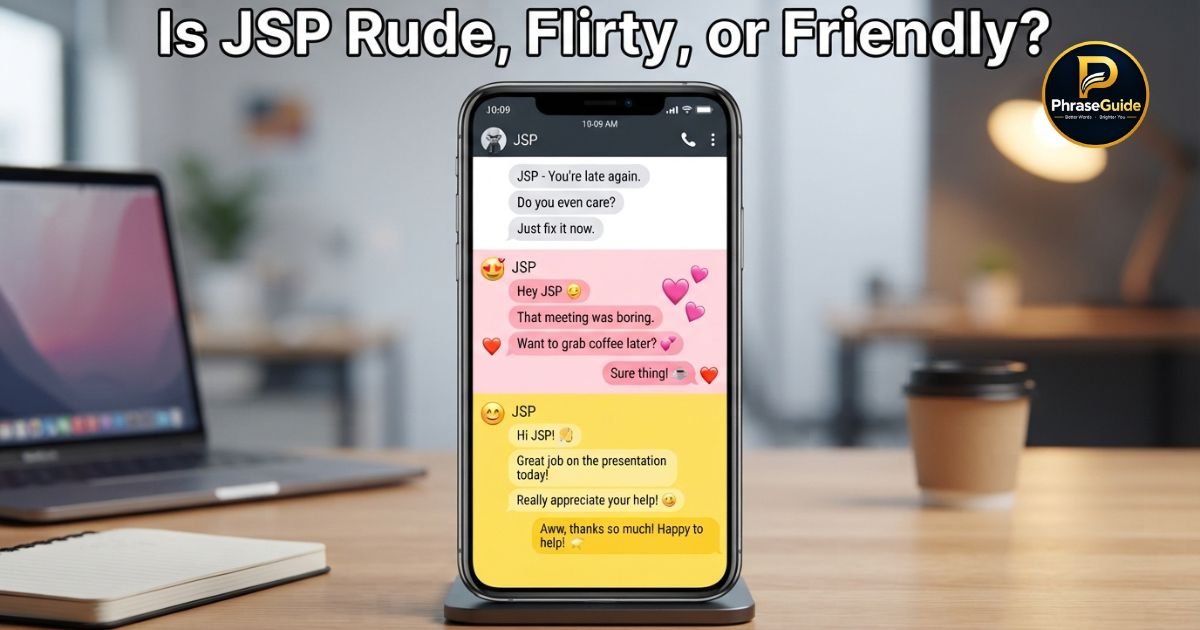
JSP is generally friendly, not rude. Its whole purpose is to soften a comment and make sure a joke lands the right way instead of sounding harsh or serious.
That said, tone still depends on what came before it:
- After a lighthearted tease (“You dress like my dad, JSP 😂”) — reads as playful and friendly.
- After a harsher comment (“You’re actually annoying, JSP”) — JSP softens it, but the comment can still sting a little depending on how it’s delivered and who it’s sent to.
- Between people who flirt or tease each other regularly — JSP can carry a flirty undertone, especially paired with a compliment disguised as an insult (“You’re so annoying… in a cute way. JSP.”).
The safest read: JSP is meant to be friendly and playful, but it isn’t a free pass to say anything without consequence. A joke that’s genuinely hurtful doesn’t become harmless just because JSP is attached to the end of it — tone and timing still matter. If you’re on the receiving end of a JSP and the comment still stung, it’s worth remembering that the sender’s intent was almost certainly playful rather than mean-spirited, even if the delivery needed some work.
How to Reply to JSP in a Text
When someone sends JSP after teasing you, the easiest replies simply match the playful tone rather than taking the comment seriously:
- “Lol okay, you’re still annoying though”
- “Sure you are 😂”
- “Rude, but okay”
- “I see how it is”
- A laughing emoji or a playful comeback of your own
There’s usually no need to overthink a reply to JSP — it’s a cue that the conversation is lighthearted, so responding in the same easygoing tone keeps the banter going naturally. If a comment genuinely bothered you despite the JSP, it’s completely fine to say so directly rather than pretending it didn’t land.
JSP vs Similar Texting Abbreviations
JSP often gets grouped with a few other short texting acronyms used to signal humor or soften a statement:
| Abbreviation | Meaning | Tone |
|---|---|---|
| JSP | Just Playing | Playful, mischievous |
| JK | Just Kidding | Slightly more corrective |
| LOL | Laughing Out Loud | Light amusement |
| TBH | To Be Honest | Sincere opinion |
| IMO | In My Opinion | Sharing a view |
| NGL | Not Gonna Lie | Honest, sometimes blunt |
The clearest comparison is JSP versus JK. Both signal that a statement wasn’t serious, but JK tends to feel like a straightforward correction (“that wasn’t true”), while JSP keeps more of the playful, teasing energy alive (“I was just messing with you”). TBH, IMO, and NGL work differently altogether — they introduce an honest opinion rather than softening a joke, so they’re not really interchangeable with JSP even though all of these fall under the same general umbrella of casual texting shorthand.
When Should You Use or Avoid JSP?
Good times to use JSP:
- Right after teasing a friend in a way you both find funny
- To soften an exaggerated or dramatic statement in a group chat
- In casual social media comments where a joke could be misread
- During light banter in gaming or online chats
- When you want to keep a compliment or a tease from sounding too serious in a flirty conversation
Times to avoid JSP:
- In professional or workplace messages, where informal slang generally doesn’t fit
- After a comment that could genuinely hurt someone, since JSP softens tone but doesn’t erase impact
- With someone unfamiliar with texting slang, where writing “just playing” or “just kidding” in full avoids any confusion
- In a serious conversation, where adding a joke tag can come across as dismissive of what’s actually being discussed
- When you’re not actually joking — tacking JSP onto a genuine complaint just to soften it can send a confusing, mixed message instead of a clear one
Used well, JSP is a small tool for keeping casual conversations light and clearly playful. Used carelessly, especially after a comment that needed more care, it can come across as an easy way to dodge the responsibility of a joke that didn’t land.
Conclusion
JSP meaning in text almost always comes down to “Just Playing” — a quick, friendly way to make sure a tease or exaggerated comment is read as a joke rather than a genuine dig. Its tone is generally playful and mischievous, closely related to JK but with a bit more banter built in, and the surrounding context (a casual joke, a French conversation, or a technical discussion about JavaServer Pages) makes the intended meaning clear almost every time. Once you know what to look for, spotting and replying to JSP in any conversation becomes second nature.
FAQS
Is JSP still used?
Yes. JSP is still encountered in both online slang and web development. In the technical world, JSP remains part of the Jakarta Pages ecosystem.
What is JSP in chat?
In casual chat, JSP can have different meanings depending on context, including “Just Playing” or other shorthand interpretations.
What is JSP in text from a girl?
The meaning does not change based on gender. If a girl uses JSP after a joke or tease, it may mean “Just Playing,” but the surrounding conversation determines the intended meaning.
What is JSP in Snapchat?
On Snapchat, JSP can be used as casual texting slang, often after a joke or playful message. However, context is important because JSP can have multiple meanings.
What does JSP mean?
JSP has multiple meanings. In casual texting it can refer to slang such as “Just Playing,” while in web development it refers to Jakarta Server Pages/Jakarta Pages

Daniel Brooks is a language and communication writer at PhraseGuide. He researches everyday phrases, texting abbreviations, slang, idioms, and common expressions to help readers understand what words and phrases mean in real conversations.
His writing focuses on clear, practical explanations that are easy to understand, with attention to context, tone, and how expressions are commonly used in everyday communication. Through PhraseGuide, Daniel aims to make unfamiliar words and phrases simple to understand.