
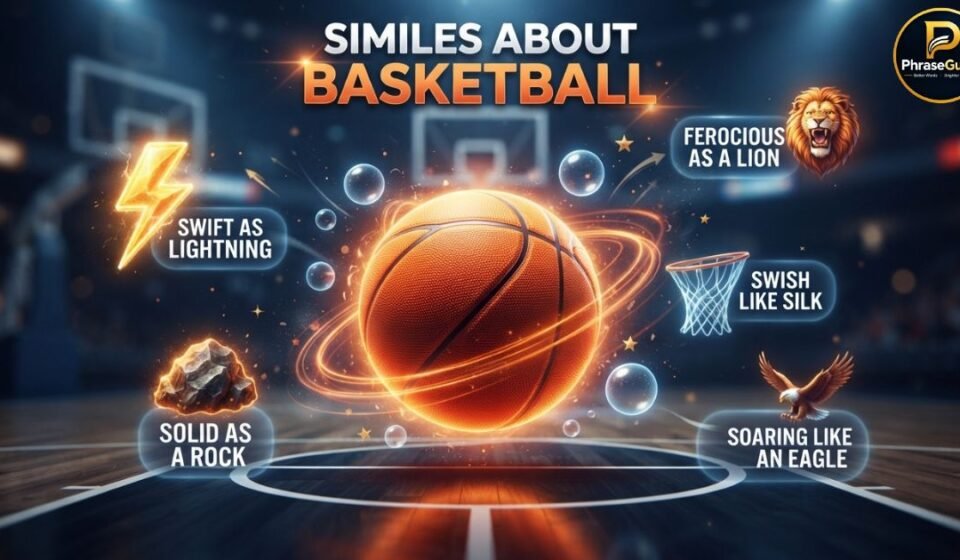

What Is a Simile in Basketball Writing?
A simile is a comparison that uses “like” or “as” to connect two different things, making a description more vivid and memorable. In basketball writing, similes about basketball help capture the speed, power, and emotion of the game in a way plain description often can’t.
Instead of simply saying a player is fast, a writer might say they move “like lightning across the hardwood.” That small shift turns a basic fact into an image the reader can actually picture, which is exactly what makes similes such a useful tool in sports writing, school essays, and creative writing about the game.
Quick Answer: What Are Some Similes About Basketball?
If you just need a few strong examples of similes about basketball right away, here are some to start with:
- Her jump shot was as smooth as silk.
- He moved through defenders like water flowing around rocks.
- The ball spun off his fingertips like a planet leaving orbit.
- Her defense was as tight as a locked door.
- The team played like a well-oiled machine.
- His hustle was as relentless as a summer storm.
- The crowd roared like thunder after the buzzer-beater.
- She rose for the dunk like a rocket leaving the pad.
Each of these follows the same basic pattern: take a basketball action or feeling, then compare it to something outside the game that shares the same quality — speed, smoothness, power, or noise.
Similes About Basketball Skills and Actions

These similes focus on the physical skills that define basketball — dribbling, passing, shooting, defending, and rebounding.
- His dribbling was as quick as a hummingbird’s wings.
- She threaded the pass through the defense like a needle through fabric.
- His shot arced through the air like a rainbow after rain.
- She boxed out like a wall refusing to move.
- His crossover snapped like a whip.
- She rebounded the ball like a hawk snatching its prey.
- His footwork was as precise as a dancer’s routine.
- The pass zipped across the court like a bullet.
- Her steal was as sudden as a lightning strike.
- His block sent the ball flying like a home run off a bat.
Similes About Basketball Players
These similes describe the players themselves — their speed, presence, or style on the court.
- She was as fearless as a lion stepping onto the court.
- He towered over defenders like a skyscraper over a city street.
- Her confidence shined like the sun breaking through clouds.
- He moved with a calm focus, like a chess player planning three steps ahead.
- She was as reliable as a sunrise, showing up big every single game.
- His energy spread through the team like fire through dry grass.
- She played with the patience of a fisherman waiting for the perfect catch.
- His leadership stood out like a lighthouse guiding a ship home.
- Her hustle never slowed, steady as a metronome.
Similes About a Basketball Game and Its Atmosphere
These similes capture the feeling of being inside the arena — the noise, the pressure, and the energy of the crowd.
- The gym buzzed with energy like a beehive at full activity.
- The tension in the final minute was as thick as fog.
- The crowd’s cheers rolled through the arena like waves crashing on a shore.
- The rivalry burned as hot as a summer afternoon.
- The final seconds ticked by as slowly as a dripping faucet.
- The arena lights blazed like a stage set for a show.
- The silence after the missed shot was as heavy as a held breath.
- The momentum shifted like the wind changing direction mid-storm.
Creative Similes About Basketball Moments and Emotions
These similes focus on the bigger moments in a game — the pressure, the joy, and the emotional highs and lows.
- Her game-winning shot felt like the final piece of a puzzle clicking into place.
- The pressure sat on his shoulders like a heavy backpack.
- Their victory tasted as sweet as the first bite of dessert.
- The comeback built like a snowball rolling downhill, gathering speed with every basket.
- His disappointment after the loss sank in like a stone dropped in water.
- The team’s joy exploded like fireworks on the Fourth of July.
- Her nerves before the free throw fluttered like a moth near a porch light.
- The final buzzer landed like a door slamming shut on the game.
Funny, Powerful, and Descriptive Basketball Similes
Not every simile needs to be serious — some work best with humor, while others aim for raw power or vivid detail.
Funny:
- His free throw missed everything, like a paper airplane caught in the wind.
- She guarded him so closely, it was like his shadow had grown legs.
- His shot clanged off the rim like a bell nobody wanted to hear.
Powerful:
- His dunk hit the rim like a hammer striking steel.
- Her defense was as unbreakable as a fortress wall.
- The team’s press defense swarmed like a pack of wolves.
Descriptive:
- The ball rolled around the rim like a coin spinning before it settles.
- Sweat dripped down his face like rain sliding down a window.
- The scoreboard glowed in the dark gym like a lighthouse beacon.
How to Use Basketball Similes in a Sentence
Similes work best when they’re woven naturally into a sentence rather than dropped in on their own. A few examples of basketball similes used in full context:
- “As the clock wound down, she dribbled like a heartbeat racing toward the buzzer.”
- “He drove to the basket like a freight train picking up speed, unstoppable once he got going.”
- “Their defense clamped down like a vice, squeezing every possession until the other team cracked.”
Notice how each simile is attached directly to an action happening in the sentence, rather than standing alone as a separate fact. That’s what makes descriptive writing feel connected instead of choppy.
How to Create Your Own Basketball Similes
Writing original similes about basketball is easier with a simple process:
- Pick the specific action or feeling you want to describe — a fast break, a missed shot, the roar of the crowd.
- Ask what that action or feeling reminds you of outside of basketball — nature, weather, machines, animals, everyday objects.
- Connect the two with “like” or “as.” (“Her speed was like a cheetah chasing prey.”)
- Check that the comparison actually fits. The best similes share a real quality — speed compared to speed, power compared to power — rather than a random or confusing pairing.
- Read it out loud. If it flows naturally and paints a clear picture, it works. If it feels forced, try a different comparison.
Strong, original similes usually come from paying close attention to a specific, real moment in a game rather than reaching for the first comparison that comes to mind.
Basketball Simile vs. Metaphor: What’s the Difference?
Similes and metaphors are both comparisons, but they work slightly differently.
| Simile | Metaphor | |
|---|---|---|
| Structure | Uses “like” or “as” | States the comparison directly, no “like” or “as” |
| Example | “Her shot was as smooth as silk.” | “Her shot was silk.” |
| Feel | Slightly softer, more descriptive | Bolder, more direct |
A simile says one thing resembles another. A metaphor says one thing is another, at least for the sake of the image. Both are useful literary devices in sports writing, and many writers use both in the same piece — similes to build a picture gradually, and metaphors for a sharper, more dramatic moment.
Common Mistakes When Writing Basketball Similes
A few habits can weaken an otherwise good simile:
- Overused comparisons. Phrases like “fast as lightning” are so common they’ve lost most of their impact — try a fresher comparison when possible.
- Mismatched imagery. Comparing a slow, deliberate post move to something associated with speed confuses the picture instead of clarifying it.
- Too many similes in a row. Stacking several similes back-to-back can overwhelm a sentence instead of strengthening it.
- Forcing a comparison that doesn’t fit. Not every action needs a simile — sometimes a plain, direct sentence communicates more clearly.
- Losing the action in the description. A simile should add to the image of what’s happening, not distract from it.
FAQs
What are 10 examples of similes? Some everyday similes include: busy as a bee, quiet as a mouse, brave as a lion, cold as ice, light as a feather, strong as an ox, sly as a fox, sharp as a tack, slow as a snail, and clear as day.
What are 10 common terms used in basketball? Common basketball terms include dribble, rebound, assist, turnover, free throw, fast break, screen, layup, foul, and three-pointer.
What are some synonyms for basketball? Basketball is informally called “hoops,” “b-ball,” or simply “the game” in casual conversation.
What are some metaphors for basketball? Common metaphors describe basketball as “a chess match,” “a battle,” or “a dance,” each highlighting a different side of the sport’s strategy, intensity, or rhythm.
What is a good basketball slogan? Simple, energetic phrases work well as basketball slogans, such as “Live for the game” or “Hustle beats talent when talent doesn’t hustle.”
Conclusion
Similes about basketball turn ordinary descriptions of speed, skill, and emotion into vivid, memorable writing. Whether you’re describing a smooth jump shot, a roaring crowd, or the heartbreak of a last-second loss, comparing basketball moments to something familiar outside the game helps readers feel the action rather than just read about it. With the examples and simple formula above, building your own original basketball similes becomes second nature.

Daniel Brooks is a language and communication writer at PhraseGuide. He researches everyday phrases, texting abbreviations, slang, idioms, and common expressions to help readers understand what words and phrases mean in real conversations.
His writing focuses on clear, practical explanations that are easy to understand, with attention to context, tone, and how expressions are commonly used in everyday communication. Through PhraseGuide, Daniel aims to make unfamiliar words and phrases simple to understand.



[…] A simile compares two different things using words such as “like” or “as.” A cold simile connects the feeling of cold to something familiar, such as ice, snow, a freezer, winter air, or a frozen lake and learn more about similes: […]