

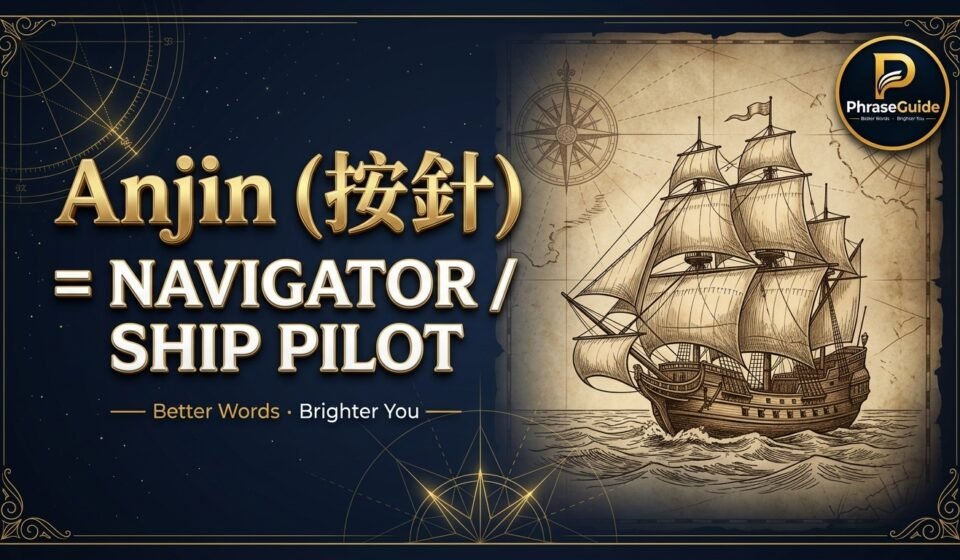

What does Anjin mean in Japanese? In its historically significant form, Anjin meaning (按針) refers to a navigator or ship pilot—someone whose skill was connected with guiding a vessel safely at sea. The word is especially associated with William Adams, the English navigator who reached Japan in 1600 and later became known as Miura Anjin.
The meaning becomes more interesting when you look at the Japanese writing, historical context, and popular culture surrounding the term. Anjin in Japanese is not simply a modern personal name with one fixed definition. The kanji and context matter, and many English-speaking readers know the word today because of Shōgun, where the fictional John Blackthorne is called Anjin.
For readers interested in other unfamiliar expressions and abbreviations, our Texting Slang & Word Meanings guide explains how context can help you understand short forms and everyday online language.
What Does Anjin Mean in Japanese?
The most direct answer is that the historical Japanese term Anjin (按針) refers to a navigator or ship pilot. Japanese historical material connects 按針 with maritime navigation and the person responsible for navigating a vessel.
That is the core answer to what does Anjin mean in Japanese, especially when you encounter the word in historical discussions about Japan, sailing, or William Adams.
The term is closely tied to maritime navigation, so “navigator,” “pilot,” or “ship pilot” are more useful English explanations than treating Anjin as a general word for a sailor. A sailor and a navigator could have different responsibilities aboard a ship.
The historical association became particularly strong because William Adams was given the Japanese name Miura Anjin after arriving in Japan. Japanese government and municipal historical sources identify Adams as an English navigator who arrived in 1600 and later served Tokugawa Ieyasu as an adviser.
| Term | Basic explanation |
|---|---|
| Anjin (按針) | Historical navigator or ship pilot |
| Japanese writing | 按針 |
| Japanese reading | あんじん |
| Famous historical figure | William Adams |
| Historical name | Miura Anjin |
| Modern popular reference | Shōgun |
| Anjin-san | Anjin + the respectful suffix -san |
So, when someone searches Anjin meaning in Japanese, the safest starting point is: Anjin (按針) is a historical maritime term associated with a navigator or pilot.
Anjin in Japanese: Kanji, Hiragana, and Meaning
The historically important spelling is 按針, written in Japanese kanji. Its reading is あんじん in hiragana, romanized as Anjin.
This matters because English letters do not show all the information contained in Japanese writing. When you see “Anjin” in Roman letters, you cannot always tell which Japanese characters were originally intended.
The kanji 針 can mean “needle” in other contexts, but that does not mean the full historical term should simply be translated as “needle.” Japanese compounds can develop specialized meanings through actual usage, and 按針 developed a maritime meaning connected with navigation. Japanese historical reference material specifically discusses 按針 as an occupational term associated with navigation.
This is why the meaning of 按針 should be understood as a historical term rather than as a word-for-word English translation of each character.
The same pronunciation can also appear with different characters in Japanese. For example, 安心 can be read anjin in Buddhist terminology, where it refers to a state of spiritual peace or stability. In everyday modern Japanese, 安心 is normally pronounced anshin and means reassurance or peace of mind.
That distinction is easy to miss when Japanese is written only in Roman letters.
Anjin Meaning Can Change With the Kanji
One of the most important things to understand about an Anjin Japanese name is that pronunciation alone does not necessarily tell you the meaning.
Think of Japanese names and terms as having three layers:
Sound → Written form → Meaning
The sound may be Anjin, but the written characters can provide information that English spelling hides.
For the historical term 按針, the established meaning is associated with navigation. But someone seeing only the Roman spelling Anjin should not automatically assume that every person, name, or expression using that pronunciation has exactly the same origin.
There is another useful example: 安心 has the same Romanized form Anjin in certain Buddhist contexts, but it has a different meaning from 按針. Japanese Buddhist sources explain 安心 (anjin) as a state of inner or spiritual tranquility achieved through faith and practice.
So if you are researching Anjin kanji, always look for the original Japanese characters rather than relying only on English transliteration.
This also explains why a simple online definition such as “Anjin means navigator” can be incomplete. It is accurate for the historical maritime term 按針, but context determines how the pronunciation is being used. The same general principle appears with texting abbreviations too; for example, CFS meaning in text can depend on the surrounding conversation and intended context.
What Did Anjin Mean Historically in Japan?

Historically, Anjin historical meaning is closely associated with maritime navigation.
The term was used in a period when ships depended heavily on human knowledge and experience. Navigators had to understand routes, direction, weather, coastlines, currents, and the practical challenges of long-distance voyages.
Japanese historical reference material describes 按針 in connection with the role of a navigator or pilot and discusses its place in early maritime vocabulary.
This gives the Japanese word for navigator a fascinating historical connection to the arrival of European sailors in Japan.
William Adams reached Japan in 1600 after a difficult voyage. His knowledge of navigation and the wider maritime world attracted the attention of Tokugawa Ieyasu. Adams later became part of Japanese political and commercial life rather than simply returning to Europe.
The historical context is important because the word became much more famous through one particular person. Over time, Miura Anjin became inseparable from discussions of William Adams and Japan’s early relations with European powers.
Miura Anjin and William Adams: Why Was He Called Anjin?
William Adams is the person most strongly connected with the historical use of the term.
Adams was an English navigator who arrived in Japan in 1600. Japanese historical sources identify him as Miura Anjin, and records from Japanese local governments describe his relationship with Tokugawa Ieyasu and his later role in diplomacy, trade, and maritime affairs.
So, why is William Adams called Anjin?
The explanation is closely connected with his professional expertise. The name Anjin was associated with his role as a navigator or pilot, while Miura connected him with the Miura area and the status he received in Japan.
Adams became useful to Ieyasu because he possessed knowledge that had practical value in a world where navigation, shipbuilding, international trade, and overseas communication depended on specialized experience.
His story also explains why William Adams Japan history is frequently discussed alongside the word Anjin.
| Historical detail | William Adams |
|---|---|
| Birth | 1564 |
| Origin | England |
| Arrival in Japan | 1600 |
| Japanese name | Miura Anjin |
| Major association | Tokugawa Ieyasu |
| Expertise | Navigation and maritime knowledge |
| Death | 1620 |
The story of Adams is documented in Japanese historical sources and is one reason Anjin historical name has such a strong connection with cross-cultural exchange.
What Does Anjin Mean in Shōgun?
For many modern readers, the word became familiar through Shōgun.
In the story, John Blackthorne is an English navigator who arrives in Japan and becomes involved in a complex political world. The character is fictional, but he was inspired by the historical William Adams. Contemporary coverage of the series explicitly identifies Blackthorne, known as “Anjin,” as a fictionalized version of Adams.
Therefore, in Shōgun, Anjin is not Blackthorne’s birth name.
Instead, it is the Japanese designation by which he is identified in the story, reflecting his role as an English navigator.
This answers another common question about Anjin in Shōgun: the word is connected to Blackthorne’s profession and his historical inspiration, rather than meaning that the character was literally born with the Japanese name Anjin.
The distinction between history and fiction matters here. Shōgun draws heavily on historical people and events, but it reshapes them for storytelling. The series is inspired by the world of Tokugawa-era Japan and by the historical figure William Adams; it is not a documentary account of his life.
The modern television adaptation was also praised in Japan and internationally for its detailed approach to Japanese language, culture, and historical setting.
Is Anjin a Name, a Title, or a Job?
The answer depends on context.
Historically, Anjin is best understood as an occupational term connected with a navigator or pilot. It later became especially well known as part of William Adams’s Japanese identity, Miura Anjin.
That means the word can appear to function like a name in historical writing while still reflecting a professional role.
It is also useful to avoid calling Anjin a modern equivalent of a formal military rank. It is not the Japanese equivalent of “samurai,” and it does not simply mean “foreigner.”
In Shōgun, the word is used for John Blackthorne because of his identity as a navigator, creating a fictionalized continuation of the historical connection to Adams.
So the simplest distinction is:
As a historical term: a navigator or pilot.
In Miura Anjin: part of William Adams’s Japanese name.
In Shōgun: the designation used for fictional John Blackthorne.
That context prevents a lot of confusion when researching the Anjin name meaning.
How Do You Pronounce Anjin in Japanese?

The basic Japanese reading is あんじん, romanized as Anjin.
For English speakers, a rough pronunciation guide is:
AHN-jeen
The first part should not be pronounced exactly like the English article “an,” and the Japanese sound pattern is generally smoother and more even than an English speaker might expect.
When learning how to pronounce Anjin, listening to native Japanese pronunciation is better than relying only on an English phonetic spelling because Romanization is an approximation.
You may see the word written as:
Anjin → あんじん → 按針
The first is the Romanized form, the second is hiragana, and the third is the historically significant kanji.
What Does Anjin-San Mean?
Anjin-san is made by combining Anjin with the Japanese honorific -san.
The Japan Foundation explains that san is placed after another person’s name to show respect or politeness.
So:
Anjin + san = Anjin-san
In English, it can be understood approximately as “Mr. Anjin,” although that does not capture every nuance of Japanese honorific usage.
This also answers what does Anjin-san mean in Shōgun. It is not a completely separate word with a new definition. It is Anjin being addressed respectfully with -san.
The difference in Anjin vs Anjin-san is therefore simple:
Anjin = the name or designation
-san = a respectful honorific added to it
Japanese uses several honorific forms depending on relationship, situation, and social context, so it is better not to treat -san as a direct one-to-one translation of “Mr.” in every situation.
Anjin vs. Similar Japanese Words and Misunderstandings

The word can become confusing because English transliteration hides distinctions that Japanese writing makes clearer.
Anjin does not simply mean “foreigner”
In historical discussions, Anjin meaning navigator is connected with maritime work. William Adams happened to be a foreigner, but his nationality is not what the word itself means.
Anjin is not the same as samurai
William Adams eventually received status and privileges in Japan, but that does not make Anjin a Japanese word meaning “samurai.” The historical term refers to navigation.
Anjin is not Blackthorne’s birth name
John Blackthorne is a fictional character inspired by William Adams. The name Anjin is part of how he is identified in the fictional Japanese setting of Shōgun.
Anjin is not always written with the same kanji
The Roman spelling Anjin does not tell you which Japanese characters are being used. 按針 is the historical maritime term, while 安心 has a different meaning when read anjin in Buddhist usage.
“Needle” is not the complete meaning
Because 針 can mean “needle,” translating the compound character by character can be misleading. The established historical meaning of 按針 is tied to navigation rather than simply to a physical needle.
Anjin is not necessarily a common modern Japanese first name
Its historical fame should not automatically be treated as proof that it is a widely used contemporary given name. The context and original kanji matter.
This kind of context-based interpretation is also common with online abbreviations. For example, JS meaning in text can require looking at the surrounding message before deciding which meaning is intended.
Anjin Meaning in Modern Japanese and Popular Culture
The word still has strong cultural visibility today, but much of its recognition among English-speaking audiences comes from history and popular culture rather than everyday conversation.
William Adams remains an important historical figure in places associated with his life in Japan, while Miura Anjin meaning continues to appear in discussions of Japan’s early international relations and maritime history. Japanese municipalities connected with Adams have also maintained projects and commemorations related to his legacy.
The other major source of modern recognition is Shōgun. The series uses Anjin for John Blackthorne, bringing a historically rooted term to a large international audience.
The 2024 adaptation was also well received in Japan for its attention to Japanese language and culture. The Japan Times described it as a major hit, while Japanese and international coverage highlighted its Japanese-language dialogue and more detailed cultural representation.
That does not mean every Japanese person watches or loves the series. Reception among individuals naturally varies, but the show clearly generated substantial attention and positive critical discussion in Japan.
Today, someone may encounter Anjin in Japanese in several very different settings:
- Historical writing about William Adams
- Discussions of Japanese maritime history
- Shōgun and its characters
- Japanese cultural and historical tourism
- Language-learning or translation discussions
- References to the historical name Miura Anjin
That is why there is no single modern interpretation that fits every occurrence. The same context-based approach is useful for online expressions too, where IDM meaning in text is understood from the surrounding conversation and intended meaning.
People Also Ask
How do you say “what the f*ck” in Japanese?
Common expressions vary by tone and situation; phrases such as “何だよ?” (nanda yo?) can express strong surprise or irritation, while more vulgar equivalents depend heavily on context.
Can I call my boyfriend “anata”?
You can, but it may sound formal or unnatural in some relationships; Japanese couples often use a partner’s name, nickname, or another familiar form instead.
Why do Japanese say “oi oi oi”?
“Oii” or “oi” can be used to call someone’s attention, show surprise, protest, or challenge something, depending on tone and context.
Is Shōgun a true story?
No. Shōgun is historical fiction inspired by real people and events, including William Adams and Tokugawa-era Japan, but the characters and story are fictionalized.
Do Japanese like the show Shōgun?
The series received significant praise and attention in Japan, particularly for its cultural detail and Japanese-language presentation, although individual opinions naturally differ.
Conclusion
The Anjin meaning becomes much easier to understand when its Japanese writing and historical context are considered together.
Anjin (按針) is historically associated with a navigator or ship pilot. The term became especially famous through William Adams, the English navigator who arrived in Japan in 1600 and became known as Miura Anjin.
For modern audiences, the word is also strongly connected with Shōgun, where fictional John Blackthorne is called Anjin. But Anjin should not be translated as “foreigner” or “samurai,” and it should not automatically be treated as the meaning of every Japanese name pronounced Anjin.
The most important lesson is simple: the Japanese kanji and context determine meaning. In historical maritime usage, 按針 points to navigation; in other contexts, the same Romanized spelling can represent something different.
Once you understand that distinction, what does Anjin mean in Japanese has a much clearer answer: historically, it is a term connected with navigation, and its remarkable connection to William Adams is what gave this short Japanese word such a lasting place in history and popular culture.