

What Does IDM Mean in Text?
IDM meaning in text most commonly stands for “I Don’t Mind.” It’s a quick way to tell someone you’re okay with a suggestion, a plan, or an option without needing to spell out a full sentence. When a friend asks where to eat or what time to meet up, replying “IDM” tells them you’re flexible and happy to go along with whatever they decide.
This abbreviation shows up constantly in everyday texting, group chats, and social media replies because it does a lot of work in three letters — it signals agreement, flexibility, and a relaxed, no-pressure attitude all at once. Unlike some texting acronyms that need context to make sense, IDM usually answers a question directly, which is part of why it’s so widely used across messaging apps.
What Does “I Don’t Mind” Mean in a Conversation?
“I don’t mind” is a phrase people use in everyday conversation to say they have no strong preference between two or more choices. It’s cooperative rather than indifferent — the person isn’t ignoring the question, they’re genuinely fine with any reasonable option and are handing the decision over to the other person.
In a conversation, “I don’t mind” usually appears as a response to a question that offers a choice:
- “Do you want to walk or drive?” — “I don’t mind.”
- “Should we watch a movie or just talk?” — “I don’t mind either way.”
The phrase carries a friendly, easygoing tone. It’s a way of saying “you choose, I’m happy either way” without sounding dismissive or uninterested. That’s an important distinction, because IDM is meant to sound cooperative, not distant — a small difference in tone that shapes how the whole message is read.
How Is IDM Used in Text Messages and Chats?
IDM shows up across nearly every messaging app and social platform, and its meaning doesn’t change much from one to the next — only the setting does.
- Text messages: Most often used when making casual plans — picking a restaurant, a movie, or a meeting time.
- Group chats: Frequently used when several people are deciding on something together, since it lets one person defer to the group without holding up the conversation.
- Instagram and TikTok DMs: Common in casual back-and-forth chats, especially when replying to a suggestion or invitation.
- Snapchat and WhatsApp: Used the same way as text messages — a fast, low-effort way to agree to whatever the other person suggests.
- Discord and gaming chats: Frequently used when choosing a map, mode, or role, where fast replies keep the game moving without slowing down the group.
Across all of these, IDM works best as an answer to a specific question or choice. It’s a texting shorthand built for quick replies, not for open-ended conversations, which is why it rarely appears as the first message in a thread — it’s almost always a response to something.
What Tone Does IDM Have?
IDM generally carries a neutral-to-friendly tone. It signals flexibility and a lack of a strong preference, which usually comes across as relaxed and easygoing rather than negative.
That said, tone isn’t fixed — it shifts slightly depending on how IDM is delivered:
- Followed by an emoji or a lighthearted comment (“IDM 😊, you pick!”) — reads as warm and cooperative.
- Sent on its own, with no punctuation (“idm”) — usually still reads as neutral, especially in casual texting where lowercase, unpunctuated replies are the norm.
- Repeated across several questions in a row — can start to feel distant or unbothered, especially if the other person is looking for a genuine opinion rather than just agreement.
Context and tone work together here. A single “IDM” in response to a casual question feels relaxed and cooperative. The same reply, used over and over when someone is clearly asking for real input, can start to send mixed signals about whether you’re actually engaged in the conversation or just going along with it to avoid deciding.
IDM Examples in Real Conversations
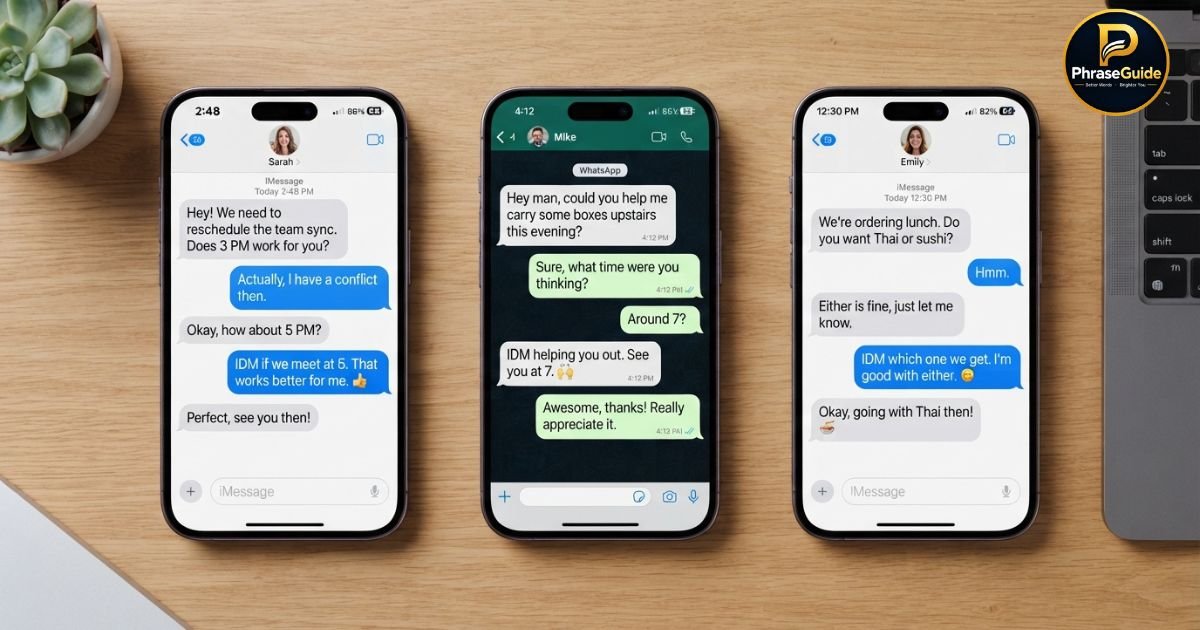
Seeing IDM in real exchanges makes its meaning and tone easier to recognize.
Making plans:
- “Pizza or burgers tonight?” — “IDM, whatever works for you.”
- “Should we meet at 6 or 7?” — “IDM, either time is fine.”
Group chats:
- “Should we do the trip in June or July?” — “IDM, I’m free both months.”
- “Movie night at my place or yours?” — “IDM lol, less cleaning if it’s yours 😂”
Gaming chats:
- “Which map do you want to play?” — “IDM, you choose.”
- “Want support or tank this round?” — “IDM, I’ll play whatever’s needed.”
Casual replies:
- “Coffee or tea?” — “idm, surprise me”
- “Can we push the call to tomorrow?” — “IDM, that works too”
In each case, IDM answers a specific choice being offered. It’s rarely used to open a conversation — it almost always responds to a question, which is part of what makes it easy to interpret correctly once you know the pattern.
Does IDM Have Other Meanings?
Yes. Outside of everyday texting, IDM can stand for a few unrelated things depending on the subject being discussed:
- Intelligent Dance Music — a genre of electronic music, often discussed in music forums and playlists.
- Identity Management — a term used in IT and cybersecurity to describe systems that manage user access and permissions.
- Integrated Disease Management — used in healthcare and public health contexts.
Want to understand another texting abbreviation? Check out our guide to STSU meaning in text.
In everyday text messages, social media, and group chats, though, “I Don’t Mind” is by far the most common meaning. The other definitions almost always appear in a specific professional or subject-based context (a tech discussion, a healthcare article, a music community), so it’s rare for them to cause real confusion in a casual conversation.
IDM Meaning in Text vs Internet Download Manager
There’s one more IDM that’s worth separating out clearly: Internet Download Manager, a well-known Windows software program used to speed up and manage file downloads.
This IDM has nothing to do with texting slang — it’s a specific, branded product name, not an abbreviation for a phrase. The two meanings almost never overlap in real conversations, since the context makes the difference obvious right away:
- “Can you send me the IDM link?” in a tech-support thread or download-related conversation is almost certainly about the software.
- “IDM, let’s just go with your idea” in a text or group chat is clearly “I Don’t Mind.”
If IDM ever shows up in a conversation about downloading files, software, or computer tools, it’s referring to the program — not the texting phrase. Everywhere else, especially in personal messages and social media, “I Don’t Mind” is the meaning to assume.
IDM vs Similar Texting Acronyms
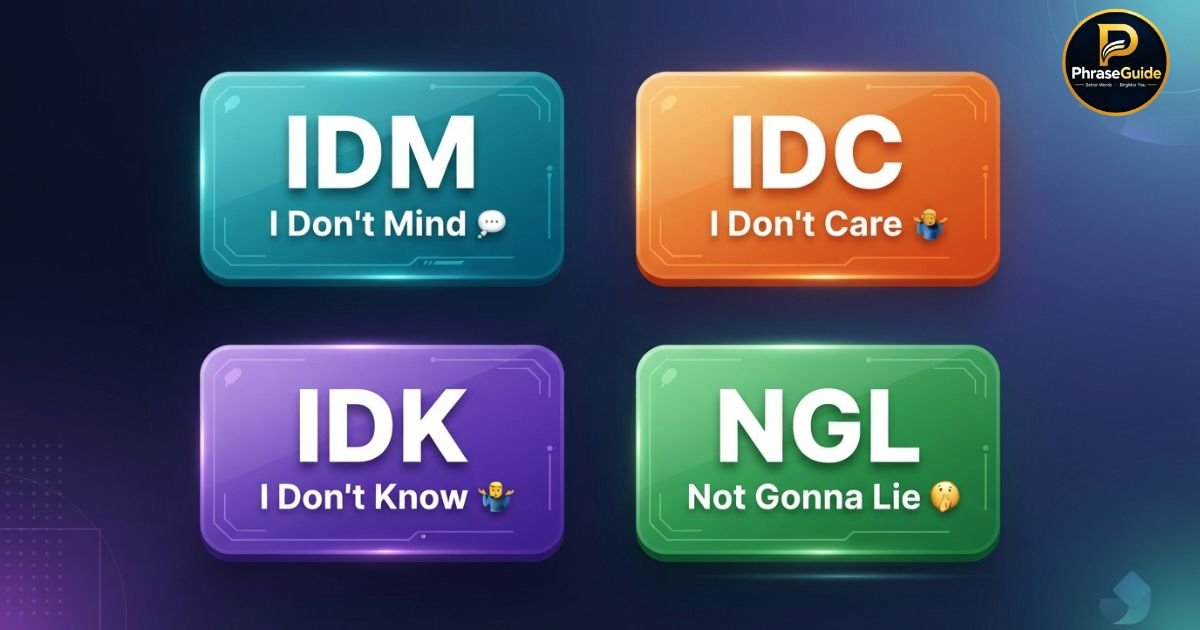
IDM is often grouped with a handful of other short texting acronyms that sound alike but carry different shades of meaning:
| Abbreviation | Meaning | Tone |
|---|---|---|
| IDM | I Don’t Mind | Cooperative, flexible |
| IDK | I Don’t Know | Neutral, uncertain |
| IDC | I Don’t Care | Can sound more dismissive |
| NVM | Never Mind | Dropping the topic |
| WGAF | Who Gives A [Expletive] | Blunt, dismissive |
The most important distinction is between IDM and IDC. Both can technically answer the same kind of question, but they land very differently: IDM suggests genuine acceptance of any option, while IDC can come across as indifference or a lack of interest in the outcome. IDK is a different situation altogether — it means the person genuinely doesn’t have an answer, rather than having no preference between known options.
Because these acronyms look similar at a glance, mixing them up is an easy mistake — but the tone each one carries is different enough that it’s worth reading twice before sending, especially in a conversation where the other person is looking for a real opinion.
Is IDM Polite, Rude, or Too Casual?
IDM is generally polite and harmless. It doesn’t contain any offensive language, and on its own, it reads as a relaxed, cooperative way to answer a question — not a rude or dismissive one.
Looking for another texting abbreviation? Check out IDM meaning in text.
It is, however, informal, which matters for where you use it. IDM fits naturally into:
- Texts and DMs with friends and family
- Group chats making casual plans
- Gaming chats and other online communities
It fits less naturally into formal emails, workplace messages, or conversations with teachers, clients, or anyone unfamiliar with texting shorthand. In those settings, writing out “I don’t mind” in full reads as more professional and avoids any chance of the abbreviation being misread or simply not understood.
When Should You Use IDM—and When Should You Avoid It?
Good times to use IDM:
- You’re genuinely fine with either option someone offers
- You’re making casual plans with friends or family
- You’re in a group chat and don’t want to slow down a decision
- You’re chatting with teammates in a game and need a fast reply
Times to avoid IDM:
- Someone is asking for your honest opinion, not just agreement
- You’re discussing something important, like work plans or a serious decision
- You’re messaging a teacher, client, or someone in a formal context
- You’ve already replied “IDM” to several questions in a row and the other person seems to want more input
The general rule: IDM works well when a decision genuinely doesn’t matter much to you. It works less well when it’s used as a way to avoid making a choice altogether, since repeated use in that situation can come across as disengaged rather than easygoing.
How to Reply When Someone Says “IDM”
If someone texts you “IDM,” the conversation is usually waiting on you to make the call. A few natural ways to respond:
- “Cool, let’s do [option].”
- “Okay, I’ll pick — how about [suggestion]?”
- “No worries, I’ll decide and let you know.”
- “Sounds good, going with [option] then.”
There’s no need to overanalyze a reply of “IDM” — it’s a signal that the other person is comfortable with your decision, not a request for further discussion. The most natural next step is simply to make the choice and move the conversation forward.
Conclusion
IDM meaning in text almost always comes down to “I Don’t Mind” — a short, friendly way of saying you’re flexible and happy to go along with whatever’s suggested. Its tone is generally cooperative and relaxed, though repeating it too often in place of a real opinion can start to feel distant rather than easygoing. Once you know how IDM is typically used across texts, group chats, and gaming conversations — and how to tell it apart from lookalikes like IDC and Internet Download Manager — reading and replying to it becomes second nature.
FAQS
What does IDM stand for?
IDM usually stands for “I Don’t Mind” in texting. It means the person has no strong preference and is okay with whatever option you choose.
What does it mean if a girl says IDM?
If a girl says “IDM,” she usually means “I Don’t Mind” and is saying she is okay with either choice. The exact tone still depends on the conversation and context.
What does IDM mean in Gen Z?
In Gen Z-style texting, IDM usually means “I Don’t Mind.” It is a casual shorthand used to express flexibility, acceptance, or a lack of preference.
What does “IDM” mean in Urban Dictionary?
Urban Dictionary does not establish one universal meaning for every abbreviation entry, and its user-submitted definitions can vary. For standard texting, IDM is commonly used to mean “I Don’t Mind.”
What does IDM mean in Snap?
On Snapchat, IDM generally means “I Don’t Mind” when used in a casual chat or message. Snapchat officially supports Chats and Snaps, but the abbreviation itself is not a special Snapchat feature or official Snapchat term.

Daniel Brooks is a language and communication writer at PhraseGuide. He researches everyday phrases, texting abbreviations, slang, idioms, and common expressions to help readers understand what words and phrases mean in real conversations.
His writing focuses on clear, practical explanations that are easy to understand, with attention to context, tone, and how expressions are commonly used in everyday communication. Through PhraseGuide, Daniel aims to make unfamiliar words and phrases simple to understand.



[…] JSP is one of many abbreviations people use in casual chats, just like IDM meaning in text. […]