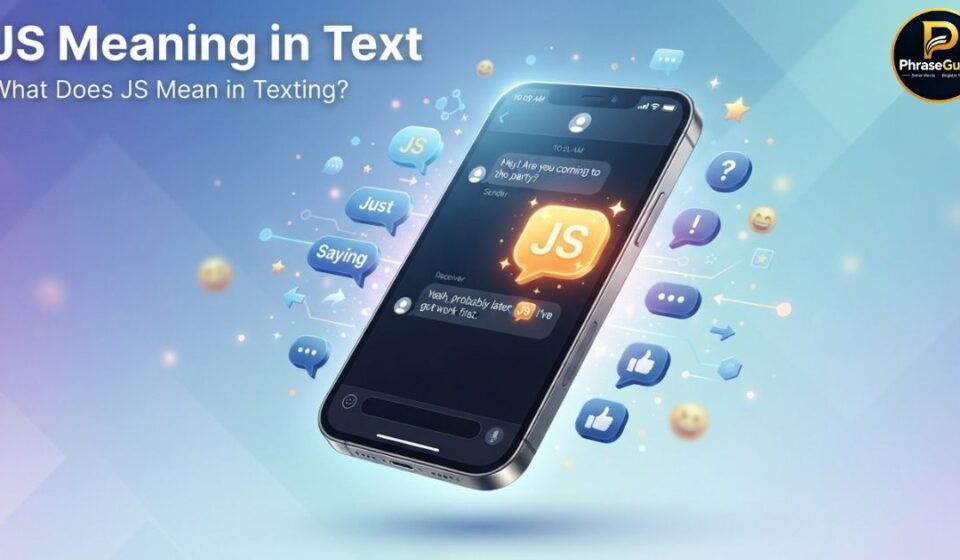

Wondering what does JS mean in text? In texting and online slang, JS usually means “Just Saying.” People commonly use it after an opinion, observation, suggestion, or comment when they want to make their point without sounding too forceful.
For example:
“You should probably leave earlier tomorrow, JS.”
Here, JS means “Just Saying.” It suggests that the sender is simply pointing something out rather than demanding that the other person agree.
The JS meaning in text can therefore be similar to phrases such as “just my opinion,” “just putting it out there,” or “that’s all I’m saying.”
However, context still matters. In some situations, JS can sound friendly and casual. In others, especially when attached to criticism, it may come across as sarcastic or slightly passive-aggressive.
JS can also have other meanings outside casual texting. For example, in technology, JS commonly means JavaScript. That is why the surrounding conversation is important when deciding what a person means.
What Does JS Mean in Text and Chat?
The most common JS meaning in texting and casual chat is “Just Saying.”
People use this texting abbreviation when they want to express an opinion, observation, or suggestion without presenting it as an absolute fact or direct command.
For example:
That restaurant is better than the other one, JS.”
The sender is giving a personal opinion. The addition of “Just Saying” can make the statement feel less direct.
Other examples include:
“You might want to call them back, JS.”
“That movie was way too long, JS.”
“You seemed happier at your old job, JS.”
In each case, the sender is adding a thought without necessarily expecting an argument.
The JS slang meaning is therefore closely connected to the idea of casually sharing something that is on your mind.
What Does “JS” at the End of a Text Mean?
When JS appears at the end of a text, it usually means the sender is adding a thought with a “Just Saying” tone.
For example:
“Maybe you should think about taking the other offer, JS.”
This can sound softer than:
“You should take the other offer.”
That small difference can matter in online communication because text messages do not contain facial expressions or vocal tone.
What Does JS Mean in Chat?
The JS meaning in chat is generally the same as its meaning in ordinary texting: Just Saying.
It can be used in:
- One-on-one conversations
- Group chats
- Direct messages
- Social media comments
- Casual discussions
- Informal online communication
The exact tone depends on the sentence around it.
What Does JS Stand For?
In casual texting, JS stands for “Just Saying.”
The phrase is usually used to signal that someone is sharing an opinion, observation, or suggestion without necessarily trying to turn it into a serious argument.
Think of “Just Saying” as a conversational disclaimer.
It can communicate ideas such as:
- “Just my opinion.”
- “I’m only pointing it out.”
- “Just putting it out there.”
- “That’s all I’m saying.”
- “You don’t have to agree.”
- “I’m just mentioning it.”
For example:
“You probably shouldn’t wait until the last minute, JS.”
The sender is making a suggestion while keeping the tone relatively casual.
Why Is “Just Saying” Used?
People often use Just Saying because it can make an opinion sound less confrontational.
Compare:
“You should probably apologize.”
with:
“You should probably apologize, JS.”
The second version may feel more like an observation or suggestion than a direct instruction.
That does not mean JS always makes a message polite. If the statement itself is insulting or critical, adding JS can still make the message sound sarcastic.
Is JS Always an Abbreviation for Just Saying?
No.
In most casual texting situations, Just Saying is the likely interpretation. However, abbreviations can have different meanings in different communities.
The most important alternative is JavaScript, especially in programming and technology discussions.
So:
“JS is easy to learn.”
could mean something very different if the conversation is about programming.
Context should always come first.
How Is JS Used in Everyday Texting?

People use JS in many everyday situations because it lets them share a thought without making the statement sound overly formal.
Sharing an Opinion
“That new restaurant isn’t as good as everyone says, JS.”
The sender is expressing a personal opinion.
Making a Suggestion
“You should probably leave earlier tomorrow, JS.”
The sender is suggesting something without necessarily telling the other person what they must do.
Pointing Out an Observation
“You seemed much happier last week, JS.”
The sender is simply pointing something out.
Giving Advice
“Maybe don’t send that message when you’re angry, JS.”
Here, JS softens the advice somewhat.
Adding a Final Thought
Sometimes people use JS after making a statement to signal that they are simply putting their view on the table.
“I think you should give it another chance, JS.”
The sender may be trying to avoid making the conversation sound confrontational.
Why People Use JS Online
There are several reasons someone might use this internet slang:
- It keeps messages short.
- It fits casual conversation.
- It can soften an opinion.
- It helps introduce a suggestion.
- It can reduce the feeling of confrontation.
- It matches the informal style of digital communication.
Still, the effect depends on the wording around JS. The abbreviation itself does not automatically make a message friendly.
JS Meaning on Snapchat, TikTok, Instagram, and WhatsApp
The JS meaning on social media generally remains “Just Saying.” Unlike some platform-specific slang, JS usually does not require a different definition simply because it appears on a particular app.
JS Meaning on Snapchat
On Snapchat, JS may appear in quick chats, replies, or informal conversations.
For example:
“You should text her back, JS.”
The meaning is simply “Just Saying.”
Because Snapchat conversations are often casual and brief, abbreviations such as JS can fit naturally into quick messages.
JS Meaning on TikTok
On TikTok, JS can appear in comments, captions, replies, or private messages.
For example:
“That was definitely the best part, JS.”
The sender is adding a personal observation.
In comment sections, however, tone can be harder to interpret because the people involved may not know each other personally.
JS Meaning on Instagram
Instagram users may use JS in DMs, Story replies, comments, and casual conversations.
For example:
“You should post more photos like this, JS.”
Here, the sender is simply sharing an opinion or suggestion.
JS Meaning on WhatsApp
On WhatsApp, JS can be used in personal chats, group conversations, or informal messages.
For example:
“Maybe we should leave earlier tomorrow, JS.”
Again, it means “Just Saying.”
JS Across Social Platforms
Whether you see JS on Snapchat, Instagram, TikTok, WhatsApp, or another messaging platform, the intended meaning is usually determined by the conversation rather than the app itself.
That is why understanding the surrounding context is more useful than relying on the platform name alone.
How to Understand the Meaning of JS From Context
Context is one of the most important parts of understanding JS meaning in conversation.
The same abbreviation can feel completely different depending on what comes before it.
If you're confused about internet slang, you may also want to learn what MYF means in text.
Look at the Entire Sentence
Start by reading the sentence containing JS.
For example:
“You should probably check the price again, JS.”
This sounds like a suggestion.
But:
“Maybe learn how to read the instructions, JS.”
could sound much more sarcastic.
The words around JS often tell you more about the tone than the abbreviation itself.
Consider the Relationship
A close friend may use JS casually because both people understand each other’s communication style.
A stranger using the same phrase may sound more critical because there is less relationship context.
Pay Attention to the Topic
If the conversation is about:
- Dating
- Work
- School
- Friends
- Money
- Personal decisions
- Arguments
the same phrase may carry different emotional weight.
Look at Emojis and Punctuation
Emojis can soften a message.
For example:
“You should try it, JS 😂”
may sound lighthearted.
Meanwhile:
“You should try it, JS.”
may sound more neutral or serious.
Neither interpretation is guaranteed, but these details can provide useful clues.
Consider Whether the Comment Is Positive or Critical
A positive statement:
“You really did a great job, JS.”
can sound friendly.
A criticism:
“Maybe show up on time next time, JS.”
may sound passive-aggressive.
That is why JS does not have one fixed emotional meaning.
JS Texting Examples and What They Mean
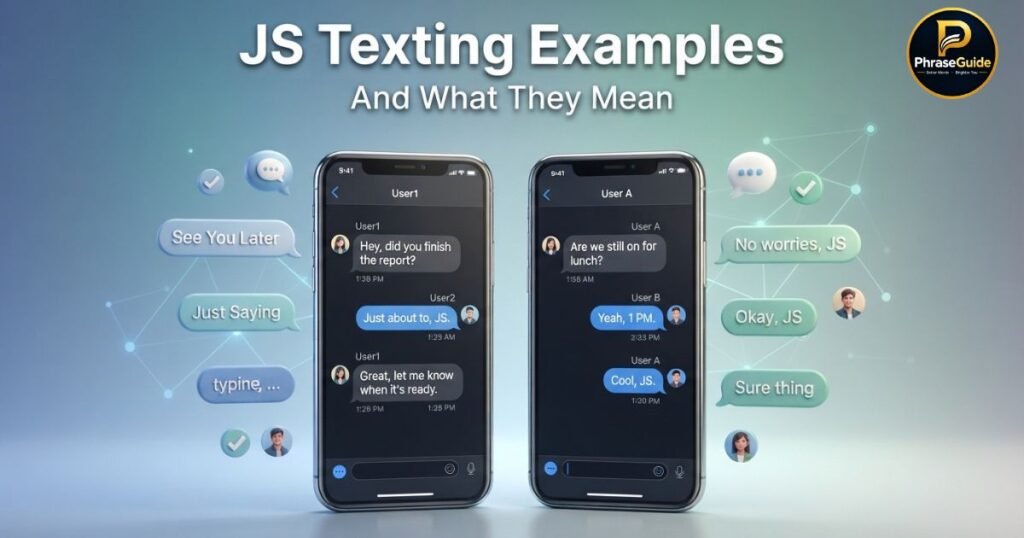
Here are some realistic JS texting examples showing how the abbreviation can work in everyday conversations.
Example 1: Casual Advice
Friend: I think I’ll wait until tomorrow to buy the tickets.
You: They might sell out, JS.
Meaning: You are giving a casual warning or suggestion.
Example 2: Personal Opinion
Friend: I love this new restaurant.
You: I think the old one was better, JS.
Meaning: You are expressing your personal opinion.
Example 3: Observation
Friend: Nobody noticed that I left early.
You: I definitely noticed, JS.
Meaning: You are pointing something out without making it sound like a major issue.
Example 4: Mild Criticism
Friend: I don’t think I need to prepare for the presentation.
You: You struggled with it last time, JS.
Meaning: You are reminding them of something while trying to keep the comment casual.
Example 5: Dating Conversation
Person A: I don’t know if I should text them again.
Person B: They seemed interested before, JS.
Meaning: The sender is offering an opinion or observation.
Example 6: Social Media Comment
Comment: This is the best movie this year.
Reply: I think the other one was better, JS.
Meaning: The commenter is respectfully sharing a different opinion.
Example 7: Friendly Encouragement
Friend: I’m not sure I should apply for the job.
You: You have a better chance than you think, JS.
Meaning: The sender is casually encouraging the friend.
These examples show that JS meaning in text is closely tied to what the sender is actually trying to communicate.
Is JS Rude, Sarcastic, or Flirty?
JS is not automatically rude, sarcastic, or flirty. Its tone depends on the sentence, relationship, and situation.
If you've come across unfamiliar texting slang, you may also want to learn what CFS means in text.
When JS Sounds Neutral
A simple observation may sound completely neutral:
“Traffic gets really bad after 5 PM, JS.”
There is no obvious criticism or emotional charge.
When JS Sounds Friendly
Friends may use JS while offering advice or encouragement:
“You should definitely apply for that position, JS.”
The friendly tone comes from the overall message, not JS by itself.
When JS Sounds Sarcastic
JS can sound sarcastic when attached to criticism.
For example:
“Maybe read the instructions first, JS.”
The speaker may be saying this sarcastically because the other person made an obvious mistake.
When JS Sounds Passive-Aggressive
Sometimes people use “Just Saying” after a critical comment to make the criticism feel less direct.
For example:
“Maybe being on time would help, JS.”
The statement may sound polite on the surface but still communicate frustration.
That is why passive-aggressive interpretations are possible even though JS itself is not offensive.
When JS Appears in Flirty Conversations
JS can also appear in a playful or flirty conversation:
“You looked really good tonight, JS.”
Here, the phrase can make the compliment feel more casual.
Likewise:
“You two seemed pretty close 👀, JS.”
could be playful teasing.
However, JS does not automatically mean flirting. The rest of the conversation determines whether there is a romantic or teasing tone.
How to Reply When Someone Says JS
Your response should depend on what the person is trying to communicate.
Casual Replies
If someone gives you a simple opinion or suggestion, you could respond:
- “Fair point.”
- “You might be right.”
- “Maybe.”
- “I’ll think about it.”
- “That’s true.”
Friendly Replies
For a supportive conversation:
- “Thanks for looking out.”
- “I appreciate the advice.”
- “I’ll keep that in mind.”
- “Good point, honestly.”
Funny Replies
If the conversation is playful:
- “JS received 😂.”
- “Noted.”
- “I’ll pretend I didn’t hear that.”
- “Too late now 😂.”
Short Replies
When you don’t need a long answer:
- “True.”
- “Fair.”
- “Yep.”
- “Got it.”
- “Maybe.”
If the Message Sounds Rude
If someone uses JS with criticism and you feel they are being passive-aggressive, you can respond calmly:
“I get your point.”
or:
“Thanks for the feedback.”
There is usually no need to escalate the conversation.
If You Don’t Understand the Meaning
If you are unsure what the sender means, ask:
“What do you mean by JS?”
This is especially useful when the surrounding conversation does not clearly indicate whether JS means “Just Saying” or something else.
Other Meanings of JS You May See
Although Just Saying is a common JS meaning in text, the abbreviation can have other meanings.
JavaScript
In programming and technology, JS commonly means JavaScript, a programming language widely used in web development.
For example:
“I need to fix the JS on this page.”
In this situation, JS clearly refers to JavaScript rather than “Just Saying.”
Personal Initials
JS can also simply represent someone’s initials.
For example, a person named John Smith could use JS as their initials.
Whether this is relevant depends entirely on the context.
Other Context-Specific Uses
In specialized conversations, organizations, industries, or communities may use JS as an abbreviation for terms that have nothing to do with texting.
This is why what does JS mean cannot always be answered without knowing the context.
For everyday text messages, “Just Saying” is the most relevant interpretation when JS is being used as casual internet slang. In a programming discussion, however, JavaScript is much more likely.
Common JS Confusions and Mistakes
Confusing JS With JavaScript
This is probably the biggest potential misunderstanding.
If you’re talking with a programmer and they write:
“The JS needs updating.”
they almost certainly mean JavaScript.
If a friend texts:
“You should go with the first option, JS.”
they are much more likely to mean Just Saying.
Assuming JS Always Has One Meaning
Abbreviations are highly context-dependent.
The same letters can represent different words in different conversations, so don’t automatically apply the texting definition everywhere.
Thinking JS Is Automatically Rude
JS itself is not inherently rude.
A friendly suggestion can end with JS, while a sarcastic criticism can also end with JS.
The tone of the complete message matters more than the abbreviation.
Assuming JS Is Always Friendly
The opposite mistake is also possible.
Adding “Just Saying” does not automatically make criticism polite.
For example:
“Maybe you should try being responsible for once, JS.”
would probably still sound insulting.
Ignoring Context
Always consider the full conversation.
Ask yourself:
- What was being discussed?
- Who is speaking?
- Is the conversation serious or playful?
- Is the person giving advice?
- Is the statement positive or critical?
- Are there emojis or punctuation that change the tone?
These clues can help you understand the intended meaning much more accurately.
Overusing JS
Using JS after every opinion can make messages feel repetitive or unnatural.
For example:
“I like this, JS.”
“I don’t like that, JS.”
“You should go there, JS.”
When used too frequently, the expression can lose its conversational effect and may even sound passive-aggressive.
Similar Texting Abbreviations and Alternatives
Several other texting abbreviations can appear in similar conversations, but they do not mean exactly the same thing.
| Abbreviation | Meaning | Typical use |
|---|---|---|
| JS | Just Saying | Softening or adding an opinion |
| IMO | In My Opinion | Clearly identifying a personal opinion |
| TBH | To Be Honest | Introducing an honest statement |
| FYI | For Your Information | Sharing information |
| JK | Just Kidding | Showing that a statement was a joke |
| NVM | Never Mind | Taking back or dismissing a previous point |
| IDC | I Don’t Care | Showing indifference |
| ICYMI | In Case You Missed It | Highlighting something previously shared |
JS vs. IMO
JS and IMO can both appear when someone gives an opinion, but they serve slightly different purposes.
IMO directly labels what follows as a personal opinion:
“IMO, the first movie was better.”
JS is more conversational:
“The first movie was better, JS.”
JS can make a statement feel less formal and sometimes less confrontational.
JS vs. TBH
TBH means “To Be Honest” and usually signals that the speaker is about to be frank.
“TBH, I didn’t like it.”
JS can be softer:
“I didn’t really like it, JS.”
The exact tone still depends on the rest of the message.
JS vs. FYI
FYI means “For Your Information.” It is usually used when providing information rather than expressing a personal opinion.
“FYI, the store closes at 8.”
JS is more likely to introduce an opinion, observation, or suggestion:
“You should probably go before 8, JS.”
JS vs. JK
JK means “Just Kidding.”
It tells the reader that the previous statement was not meant literally.
JS does not mean that the sender was joking. It generally means “Just Saying.”
Choosing the Right Expression
The best abbreviation depends on what you want to communicate:
- Use JS for a casual opinion or observation.
- Use IMO to clearly identify a personal opinion.
- Use TBH when emphasizing honesty.
- Use FYI when simply providing information.
- Use JK when clarifying that something was a joke.
The main takeaway is that these abbreviations may appear together in online conversations, but each one communicates a different idea.
When you see JS in text, the most likely meaning is “Just Saying.” It is commonly used to add an opinion, suggestion, or observation in a casual way without making the statement feel overly forceful.
The exact tone can change, however. JS can sound friendly, neutral, sarcastic, or even slightly passive-aggressive depending on the words surrounding it.
The abbreviation can also mean something else, especially JavaScript in technology-related conversations. So the safest way to understand the JS meaning in text is to read the entire message and consider the context.
In simple terms, JS usually means “Just Saying” in casual texting and social media. Once you look at the surrounding conversation, its intended meaning is usually much easier to understand.
FAQS
What is JS in Gen Z slang?
In Gen Z slang, JS usually means “Just Saying.” It is used to add a casual opinion, comment, or statement without sounding too serious or confrontational.
What does “JS” stand for in chat?
In chat and texting, JS most commonly stands for “Just Saying.” For example, “JS, I think the first option is better” means “Just saying, I think the first option is better.”
What does JS mean for short?
JS is a shortened form of “Just Saying.” People use it in texts, social media comments, and online conversations to express an opinion or add a casual remark.
What does JS mean on TikTok?
On TikTok, JS usually means “Just Saying.” It is often added to a caption or comment when someone wants to share an opinion or observation casually.

Daniel Brooks is a language and communication writer at PhraseGuide. He researches everyday phrases, texting abbreviations, slang, idioms, and common expressions to help readers understand what words and phrases mean in real conversations.
His writing focuses on clear, practical explanations that are easy to understand, with attention to context, tone, and how expressions are commonly used in everyday communication. Through PhraseGuide, Daniel aims to make unfamiliar words and phrases simple to understand.